It’s been a while since I’ve posted on this blog since I have had other priorities. I read 5 books in May. Here is a blurb of each of the books I read in May.
“Supersized Lies: How Myths About Weight Loss Are Keeping Us Fat – And the Truth About What Really Works” was written by Robert J. Davis, PhD, host of the Healthy Skeptic video series and an award-winning health journalist whose work has appeared on CNN, PBS, WebMD, and the Wall Street Journal. Here are some main points:
Instead of focusing on individual villains, we need to pay attention to the general quality of our diets – emphasizing whole foods and minimizing highly processed foods – vegetables, fruits, beans, nuts, seeds, seafood, lean poultry, and whole grains, such as oats and rice. Whole foods tend to have fewer calories per ounce, more fiber, and be more filling, and we often eat them more slowly, giving our brains time to get the message that we’ve had enough.
When calories are cut or increased by a specific amount, the change in weight will vary from person to person, and these differences are due at least in part to genetics.
Calories shouldn’t be the only consideration. That can detract from the pleasure of eating, contribute to an unhealthy relationship with food, and result in too little of the things your body needs. Instead, when choosing what to eat, also pay attention to the sugar, fiber, and protein, and consider how healthful and filling the foods are and how you feel after you eat them.
It takes A LOT of work to burn off the calories in a relatively small amount of food. Changing your diet to lose weight is easier than exercising to lose weight.
If dietary supplements had to meet the same standards of proof for safety and effectiveness as medications, few, if any, would be allowed on the market. Supplement makers aren’t required to test for safety. The law assumes that supplements are innocent until proven guilty – just the opposite of how medications are regulated.
Exercise, sleep, and stress management reinforce each other to benefit not only our physical and emotional health, but also our weight.
4 out of 5 stars
“Selling the Dream: The Billion-Dollar Industry Bankrupting Americans” was written by Jane Marie, a Peabody and Emmy Award-winning journalist. In this book, Jane expands on her popular podcast The Dream to expose the source of multilevel marketing schemes. Although I have never been involved in multilevel marketing (thankfully), I got a lot out of this book! Here are some main takeaways:
99% of those who join MLMs make no $ or even lose $. Women make up 74% of the MLM workforce.
In an MLM, the product being sold doesn’t matter since most of the $ is being made via recruitment fees and distributors stocking their own shelves with inventory.
Despite what those in MLMs may believe, they are not business owners. They don’t control anything except their own sales efforts. They don’t own the product they’re selling or any IP, they don’t set their own prices or salaries, and they are often bound by strict rules in how they can market and sell the products. They also lack a guaranteed salary, benefits, and workers’ rights.
The MLM world is a bizarre land where incentives can range from the opportunity to buy your own ticket to a conference to earning a new rank solely based on products you’ve purchased that now sit in your garage. The disincentives are just as plain: once you’ve roped in your friends and family, quitting seems off the table and an admission that you sold them a bill of goods.
“Nutrition” clubs are seemingly popping up everywhere. One of the most fascinating things I read in this book is that Herbalife nutrition clubs prohibit signs that state or suggest that Herbalife products are available for retail purchase on the premises. Club owners are not permitted to post signs indicating whether the club is open or closed, and the interior of the club must not be visible to persons outside.
I recommend reading this book if you want to learn more about the MLM industry.
4 out of 5 stars
“I Wish I Knew This Earlier: Lessons on Love” is an essay-type book divided into themes and written by Toni Tone, an award-winning speaker, writer, and social content creator. Here are some points that resonated with me:
Intimacy tells you more about a relationship than intensity. Can you be vulnerable? Do you feel safe? Is there trust? Do you have similar interests? Can you easily hold a conversation with them? Do you have similar values?
Have a life outside of your love life is essential. A healthy relationship should complement your life, not become it. A partner who is good for you wants you to flourish and wants you to be the best version of yourself. The best version of yourself is well-rounded, has friendships outside of your romantic relationship, hobbies, and aspirations outside of your romantic relationship.
We should choose to love people for who they really are because the painful truth is that potential doesn’t always manifest.You may think a person is capable of moving mountains for you, but should these mountains never be moved, how will you feel? Falling for potential is not just a disservice to you but it’s also a disservice to the person you are choosing to love. We don’t possess the power to change people. People change because they want to.
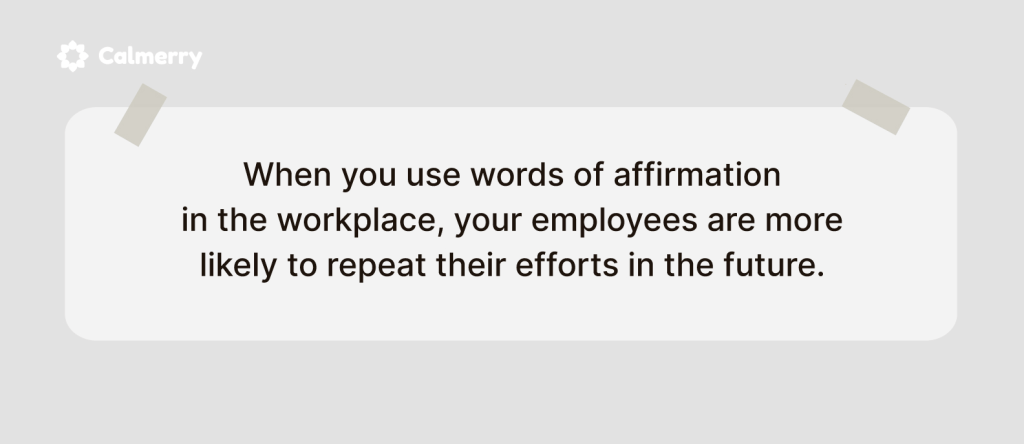
Don’t forget to celebrate your partner. Share compliments, provide words of affirmation, and give praise where it’s deserved. Don’t speak up only when you are annoyed. Speak up when you are happy too.
I highly recommend this book to anyone!
5 out of 5 stars
“Love is a Choice: 28 Extraordinary Stories of the 5 Love Languages in Action” was written by Gary Chapman, author, speaker, and counselor and #1 bestselling author of The 5 Love Languages series. Here are some great points:
Realize that you have as many faults as your partner. “Fix your thoughts on what is true, and honorable, and right, and pure, and lovely, and admirable. Think about things that are excellent and worthy of praise.” Philippians 4:8
Perhaps one of the keys to finding an enduring affection is to be willing to accept the interruptions and intrusions.
How do you measure love? Each of us speaks a different love language. How can we learn someone’s love language? By asking them what makes them feel really loved or by watching how the person expresses love to others.
Love doesn’t require that we always have all the answers. Instead, many times love just asks that we listen to the problem, that we try to understand, and that we express our condolences, sympathy, or love. Sometimes love means just being there for the person we care about.
Love requires effort and action. Love is not passive. It requires constant effort, communication, and care. Actions like making time for each other, showing affection, or helping with everyday tasks can strengthen a relationship in profound ways.
Open, honest, and empathetic communication is necessary to foster understanding and connection. Instead of assuming your partner knows what you need, communicate your feelings, desires, and needs clearly. Practice active listening and empathy.
4 out of 5 stars
“Compassion in the Court: Life-Changing Stories From America’s Nicest Judge” was written by Judge Frank Caprio, who became an unexpected television and internet superstar while in his eighties. Judge Caprio’s three-time Emmy-nominated television show, Caught in Providence, has amassed over 20 million followers across social media and his videos have accrued billions of views. Here are some key lessons:
True justice should be tempered with compassion. Treat people as human beings, not just as cases or statistics.
Compassionate decisions build trust in the judicial system. When people feel that they are treated fairly and with understanding, they are more likely to follow the rules and make positive changes.
What may seem unimportant to you could be incredibly important and life-changing to the person before you. One small act of kindness, one act of being thoughtful, can really change the course of a person’s life.
Put yourself in the shoes of the person you are facing and then ask yourself: What would help? How would you behave if it were your parents, grandparents, brother, sister, or relative in that situation? How would you want them treated?
My courtroom was a microcosm of the city of Providence, a progressive city that’s been welcoming immigrants for hundreds of years. Many of the defendants who have appeared before me may not have felt life had treated them fairly, but it was my sincere hope that in my courtroom they felt that they had the opportunity to speak, to be heard, and to be treated fairly in the way our system of justice demands.
4 out of 5 stars
I look forward to reading, learning, and sharing more with you soon!
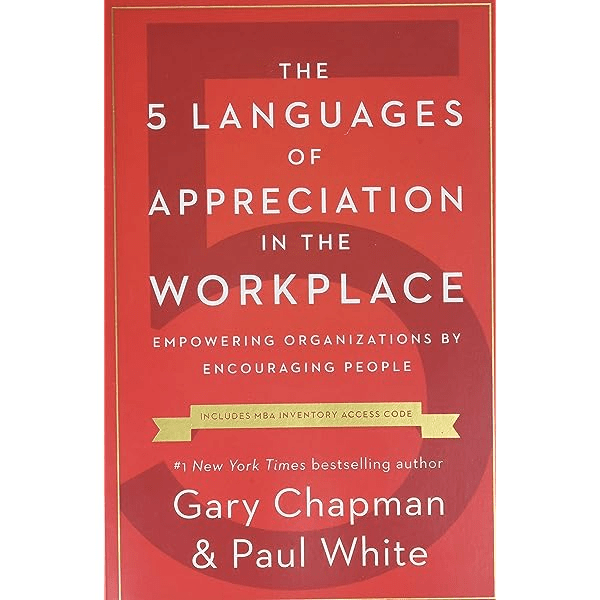
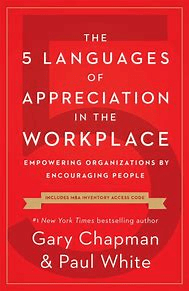
I read “The 5 Languages of Appreciation in the Workplace” written by Dr. Gary Chapman and Dr. Paul E. White as part of a book club I am in. Dr. Gary Chapman is the #1 New York Times best-selling author of “The 5 Love Languages.” Dr. Paul E. White is a psychologist, author, speaker, and consultant who helps make work relationships work. This book was very intuitive and fascinating!
The number one factor in job satisfaction is not the amount of pay but whether or not the individual feels appreciated and valued for the work they do.
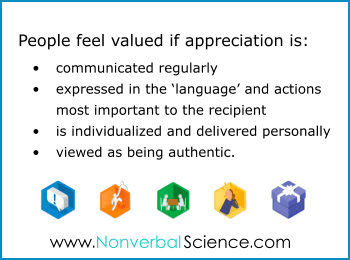
The reality is that what makes one person feel appreciated does not make another person feel appreciated. For recognition and appreciation to be effective, they must be individualized and delivered personally. Appreciation needs to be viewed as valuable to the recipient in order to have an impact. Employees are more likely to “burn out” when they do not feel appreciated or emotionally supported by their supervisors or colleagues.
The greatest need of a human being is psychological survival, to be understood, to be affirmed, to be validated, to be appreciated.
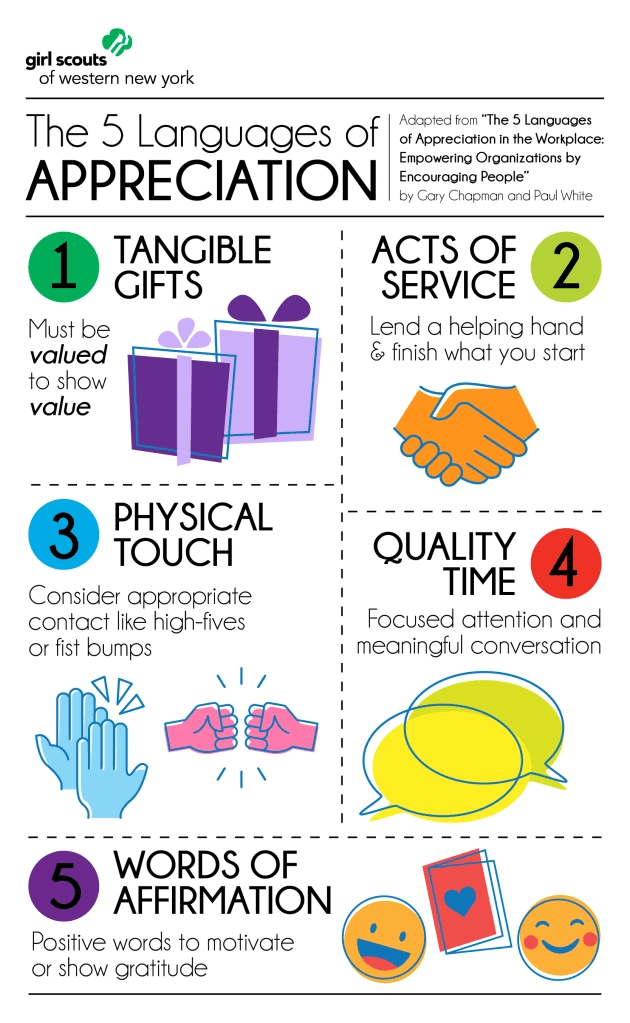
The 5 languages of appreciation in the workplace are:
Words of affirmation
Quality time
Acts of service
Receiving gifts
(Appropriate) physical touch
Words of affirmation (my #1 preferred language of appreciation):
Praise typically focuses on a specific task. Praise can also focus on verbally affirming positive character traits.
Common settings for words of affirmation: personal, one-on-one, praise in front of others, written affirmation, public affirmation
You can show words of affirmation by sending an e-mail with kudos, telling others about the good job someone is doing, giving a specific compliment, writing a handwritten note of appreciation, or giving encouragement.
Be aware that some people dislike public recognition!
Quality time:
Can consist of quality conversation, shared experiences, small group dialogue, or working in close proximity with coworkers
Because you have listened to them, they will also listen to you
Working closely with others can make work feel more valuable.
Ideas for quality time: go to lunch together, check in with people to see how they are doing, take a walk together, or get together for a sporting or social event.
Acts of service:
“Don’t tell me you care; show me”
Ask before you help, and if you’re going to help, do it their way. Clarify how they want it done.
Serve voluntarily, check your attitude (don’t complain), and complete what you start.
Receiving gifts:
You need to give gifts primarily to those individuals who appreciate them.
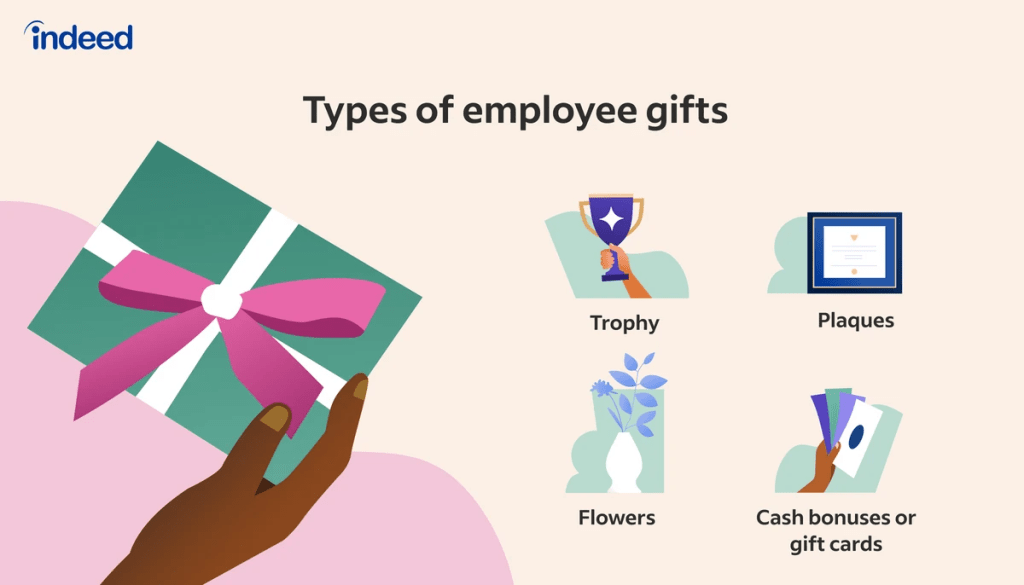
You must give a thoughtful gift that the person values. Ask questions about their interests (sports, restaurants, spa, theatre, etc.). Giving a coffee mug or pen with the company logo on it will not make the person feel valued.
Appropriate physical touch:
Appropriate physical touch may include handshakes, fist bumps, high fives, or pats on the back.
The question is not “Do you appreciate your coworkers?” The real question is “Do they feel appreciated?”
To figure out others’ language of appreciation, observe their behaviors, observe what they request of others, and listen to their complaints. The things about which an individual complains may reveal their primary appreciation language.
Another way to figure out others’ language of appreciation is to have them take the Motivating by Appreciation (MBA) Inventory.
Cues that your colleagues need to feel appreciated: discouragement, irritability and resistance, increased absenteeism and tardiness, cynicism and sarcasm, apathy and passivity, social withdrawal, and a negative work environment.
Be aware of your potential blind spot. The language of appreciation least valued by you will seldom be spoken. When a colleague’s least important language of appreciation is words of affirmation, no matter how much you praise them, it misses the mark.
One of the most common reasons we lack appreciation for coworkers is that we have unrealistic expectations of them. Don’t let differences influence you. In the work setting, the question is “Are they performing their job in a satisfactory manner?” If not, consider personal problems at home, inadequate training, or a lack of feedback/review/correction.
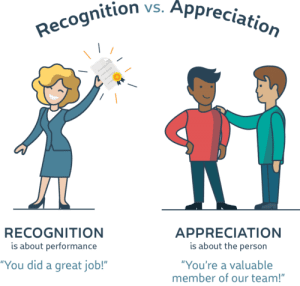
While recognition focuses primarily on performance or achievement, appreciation focuses on the value of the individual employee. Isn’t there a place for appreciation even when someone messes up?
Volunteering:
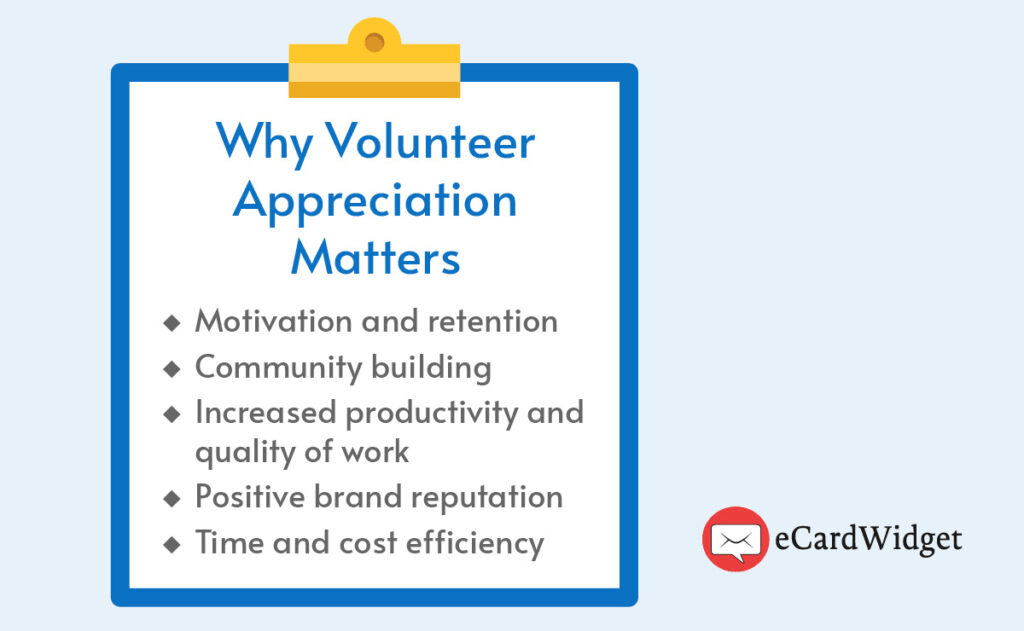
Low job satisfaction increases job turnover, turnover affects the quality of services delivered, and volunteers are more likely to quit because their efforts go unrecognized.
Many volunteers report the main reason they quit is a sense of isolation and lack of support from others.
People continue to volunteer to make a difference, socialize, and receive positive feedback.
Volunteers need input and perspective from their supervisors in order to understand the impact they’re truly having.
When a person receives an adequate supply of their primary language of appreciation, the secondary language may then become more important. It is reasonable to expect that an individual’s preferred language of appreciation may vary significantly over time in response to different life events, life stages, and the individuals with whom they are interacting.
I look forward to reading, learning, and sharing more with you soon!
My intention is to post a Thoughtful Thursday column each week and share some of the insights I have learned in the past week. Here are some of the things I’ve learned this week:
Chasing Life – Breaking Up (and Making Up) with Your Phone
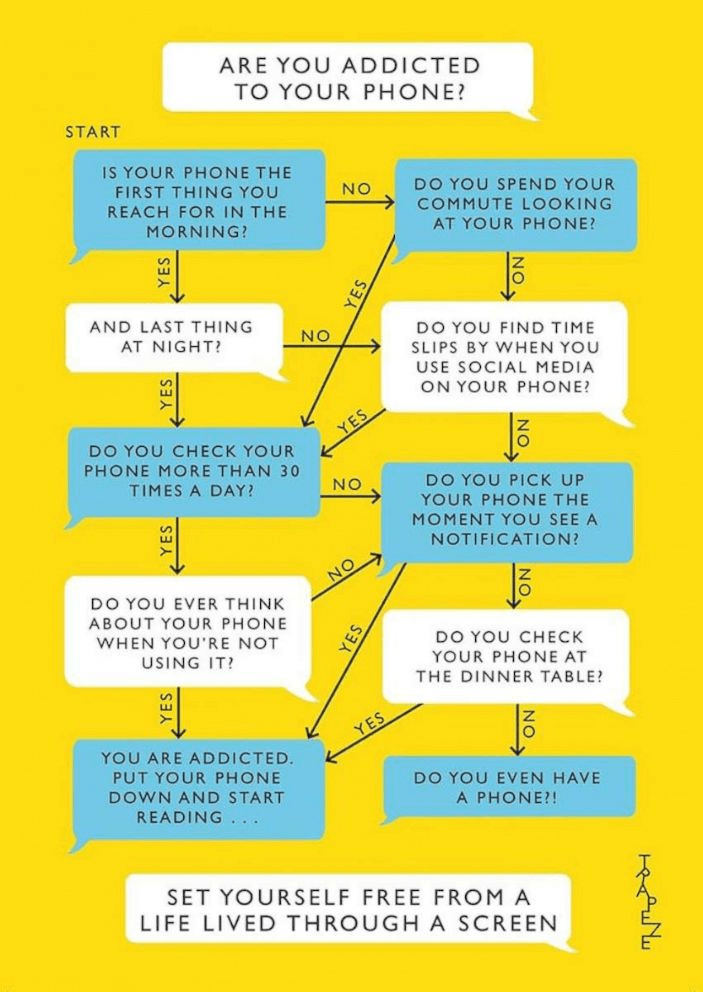
The average person checks their phone more than 300 times per day. Many people feel they are expected to answer e-mails and texts quickly.
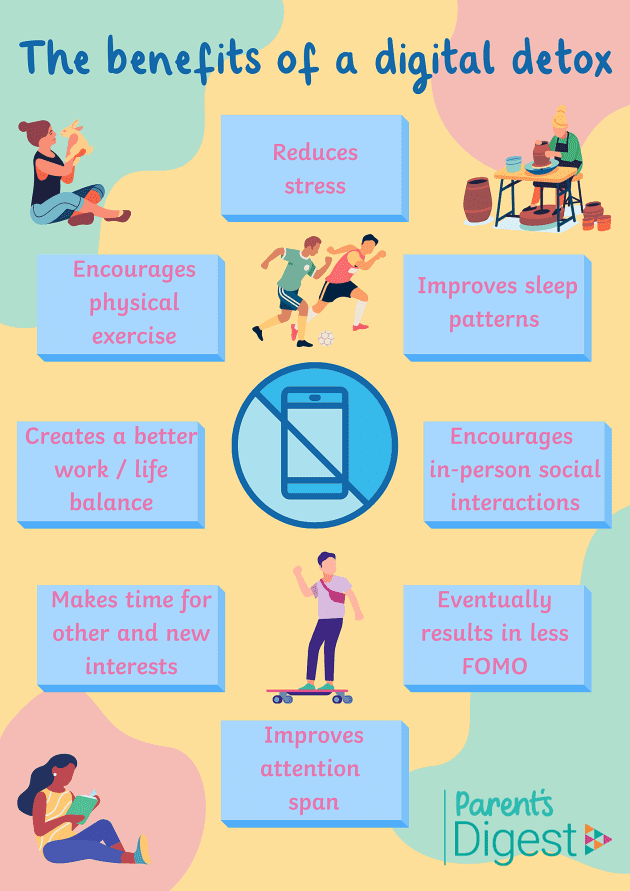
Get in the habit of taking a break so that you can both better understand the effect your relationship with technology is having on you and also appreciate its benefits more.
Take a digital sabbath. Have a 24-hour period where you don’t interact with your devices. It can be accompanied by a sense of physical relaxation and calm that’s so profound that many people report they don’t want to turn their devices on after 24 hours.
Many people think that the first step to break up with your phone is to delete apps. The first step is actually to take a moment of self-reflection and think about how your phone is helping and hindering you. Example: Are you actually present with those around you or are you scrolling through social media or your e-mails? Consider which apps are useful and which are a waste of time that make you feel bad after you use them. Delete those apps that don’t serve you. You can always check something from your browser or desktop, change your settings to turn to black and white, disable notifications, uninstall apps (and reinstall later if necessary).
Create rules such as no phones at the table. On average, someone is likely to reach for their phone several times during a meal.
We end up spending more time on our phones than planned because they are designed to maximize time spent on them.
When the phone is in your hand, ask yourself: What for? Why now? What else? Most of the time it’s going to be an emotional reason (anxiety, boredom, lonely). Ask yourself what else you could do in that moment to achieve that same result. Ex: call someone or take a walk instead of scrolling endlessly on social media.
Trying to change a habit through willpower is a guaranteed way to fail. Instead, consider what you want to be doing with your time. What do you say you want to do but you don’t because you think you don’t have time for it? Limiting time on your phone will make you realize you suddenly have more time. Considering putting your phone in another room for a while so that you can focus on what you need to get done.
Our lives are what we pay attention to. You’re only going to experience and remember what you pay attention to. Be intentional about your attention. We get to construct our lives every day by deciding what we pay attention to. Is my life TikTok or is it a sunrise, a fresh flower, an amazing book, or my smiling kid’s face?
Start by being aware of how you use your devices and the impact they are having on your in-real-life relationships. Every time you pick up your device, answer: What for? Why now? What else? By asking yourself these questions and reflecting on them, you can start to rebuild your relationship with your device and with others.
The Verywell Mind Podcast – Encore: Communication Mistakes Most Couples Make
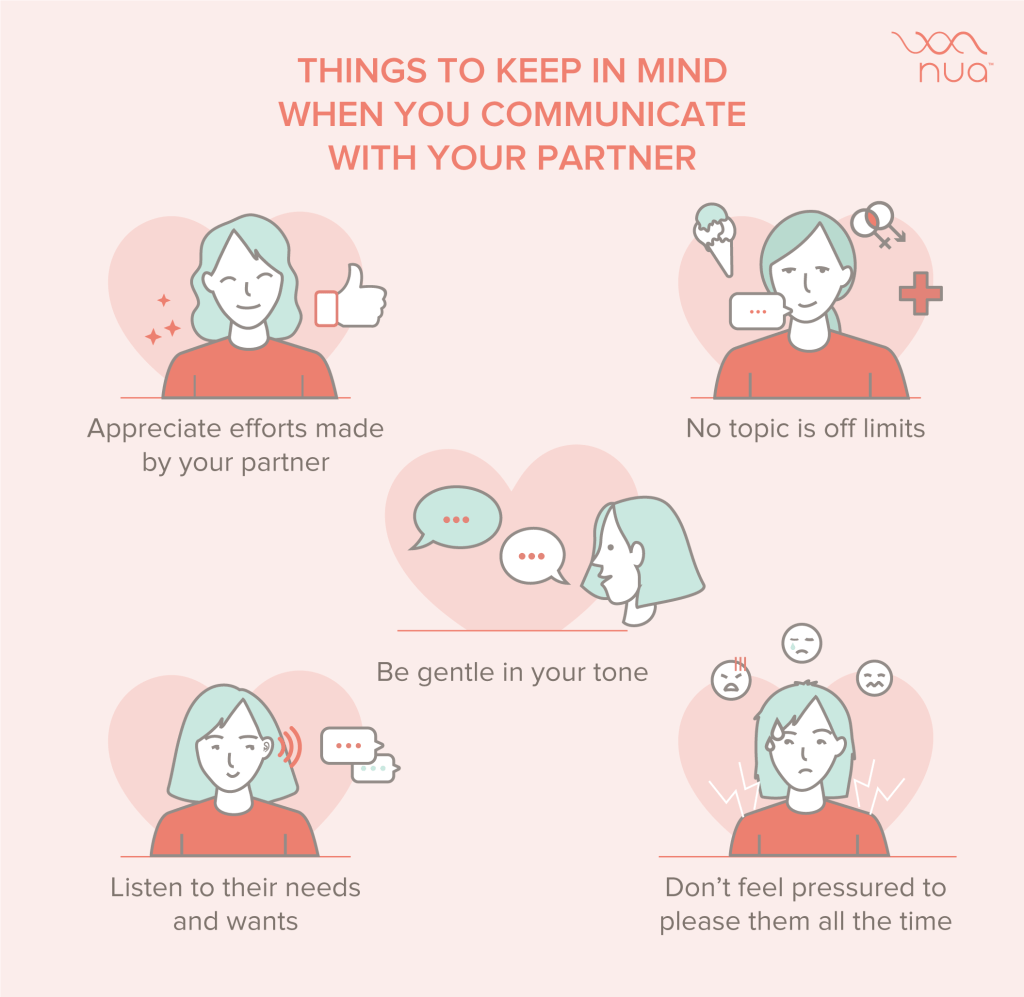
Don’t stonewall your partner. Essentially it involves anything that you do to further stop communication, such as the silent treatment, saying you’re fine when you’re not, saying you aren’t mad when you’re clearly upset. Stonewalling indicates you don’t care enough to work through something. It’s damaging to a relationship and prevents you from solving problems together.
Never get too busy to communicate. Many couples don’t take time to sit down and talk. When they do, they’re distracted by their phones or the tv. It’s easy to get so caught up in your busy life that you end up only communicating about the business part of your relationship. It’s important to keep getting to know each other and make time to talk about deeper issues, such as your goals, hopes, dreams, fears, and things you’re working on to become better people. Deeper conversations can help you connect on a different level.
Talk about your boundaries and expectations. Secrets can destroy relationships, so it’s important to be upfront and open.
Don’t offer cheap forgiveness. Don’t say you aren’t mad when you are clearly mad. Forgiveness takes work. Both of you need to be willing to work through the issue rather than pretend it’s not a problem.
TED Talks Daily – 5 steps to building a personal brand you feel good about
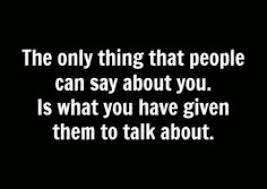
Whether you realize it or not, you have a personal brand. It’s your reputation and how people perceive you. It’s what people think about you when they hear your name and what people say about you when you’re not in the room.
Whenever we engage with people both in person or online, every interaction, every post, and every comment creates a reputational narrative about ourselves. Do you want to be the one who’s driving and shaping the story or do you want the algorithms to do it for you?
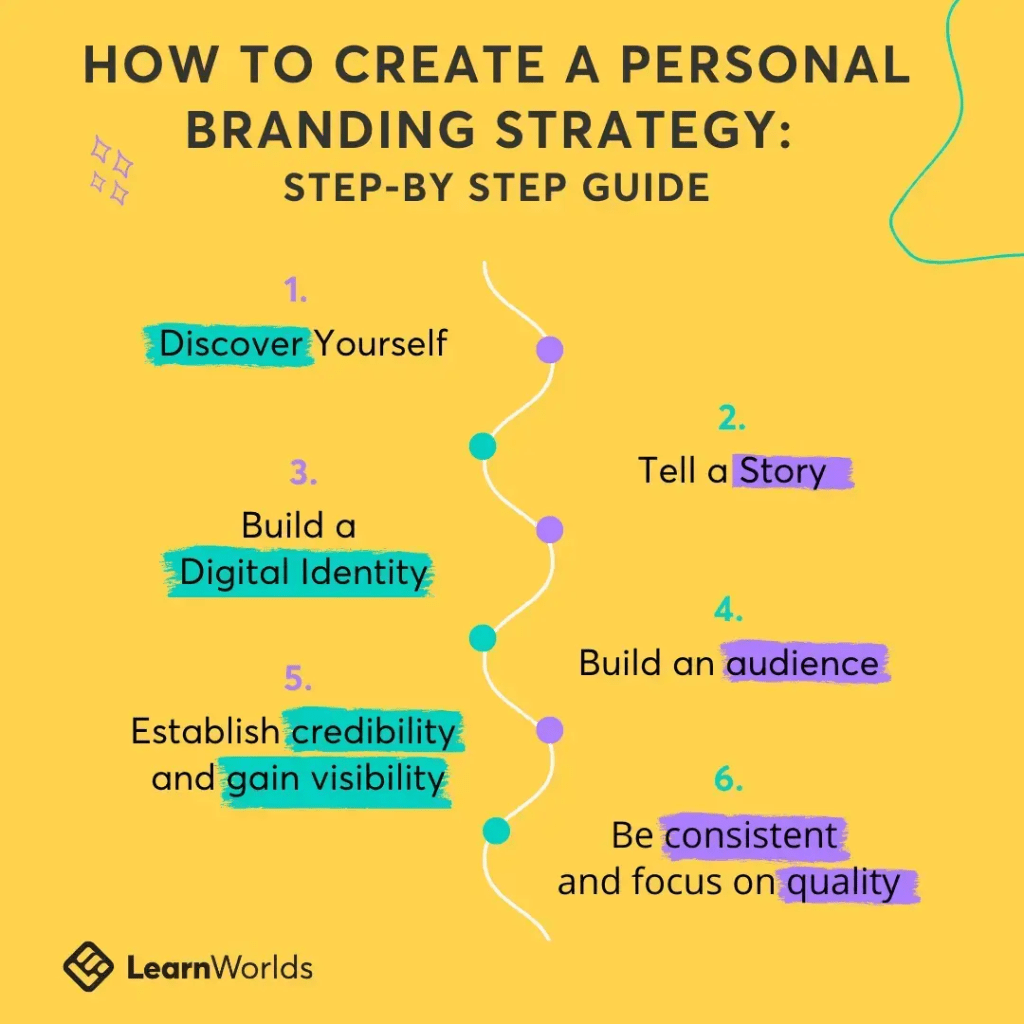
5 steps to creating a personal brand:
Figure out what your goal is. What do you want your personal brand to help you accomplish? Are you looking to change jobs or transition into a new industry? Are you looking to get a promotion? Are you launching a new business?
You will want to get clear on what you want to be known for. Start by answering “What do you do?” Dig deeper into the what, how, and why behind your work. What are the things that make you unique? Are there specific talents and expertise that you’ve acquired in your career? What do you know more about than most people? Your personal brand is not about you. It’s about the people you want to educate with the skills, knowledge, and value you can provide. Who can most gain from what you have to share, and how exactly can you see yourself helping them?
Put all of your answers into a single mission statement that describes who you are, what you do, who you do it for, and the transformation you can create in people’s lives. Mission statements will look wildly different depending on who you are in your career.
Build a personal brand online by developing a personal website and social media. A personal website allows you to take full control over your online reputation. It offers the most flexibility in sharing your brand and value to others in a much deeper way than a resume or LinkedIn profile.
Social media is also a great way to share your personal brand with the audience you most want to connect with. When posting, focus on being helpful to others. Share interesting articles, post ideas or opinions that can benefit people, and focus on engaging in commenting and liking posts of those you follow.
In a sense, this educational blog and sharing helpful information with others is part of my personal brand.
Fit, Healthy & Happy Podcast – 10 Things We Wish We Knew Before We Started Lifting
Lift weights before doing cardio. If you want to gain strength, prioritize weights. You’ll be too tired to lift at your full potential if you tire yourself out with cardio first.
Lift with purpose and intensity. Have a plan or goal in mind.
It never hurts to ask for help. Gym staff and others are always willing to help.
Aim to go at a consistent time. Your body becomes adapted to the routine and it becomes habit. You’ll also start seeing the same people, which will make you feel more comfortable.
Hire a personal trainer to save you time, money, and energy in the long run.
Don’t be afraid to fall and learn how to fail.
Place a 10 lb plate underneath your weights when adding plates for deadlifts.
Realize people aren’t judging you. Most of the time, people are focused on themselves and how they look instead of judging you.
Take it slow and start with less weight and work up. Focus on the quality of each movement.
Watch form videos before going to the gym.
Optimal Finance Daily – Estate Planning 101 by Jesse Cramer
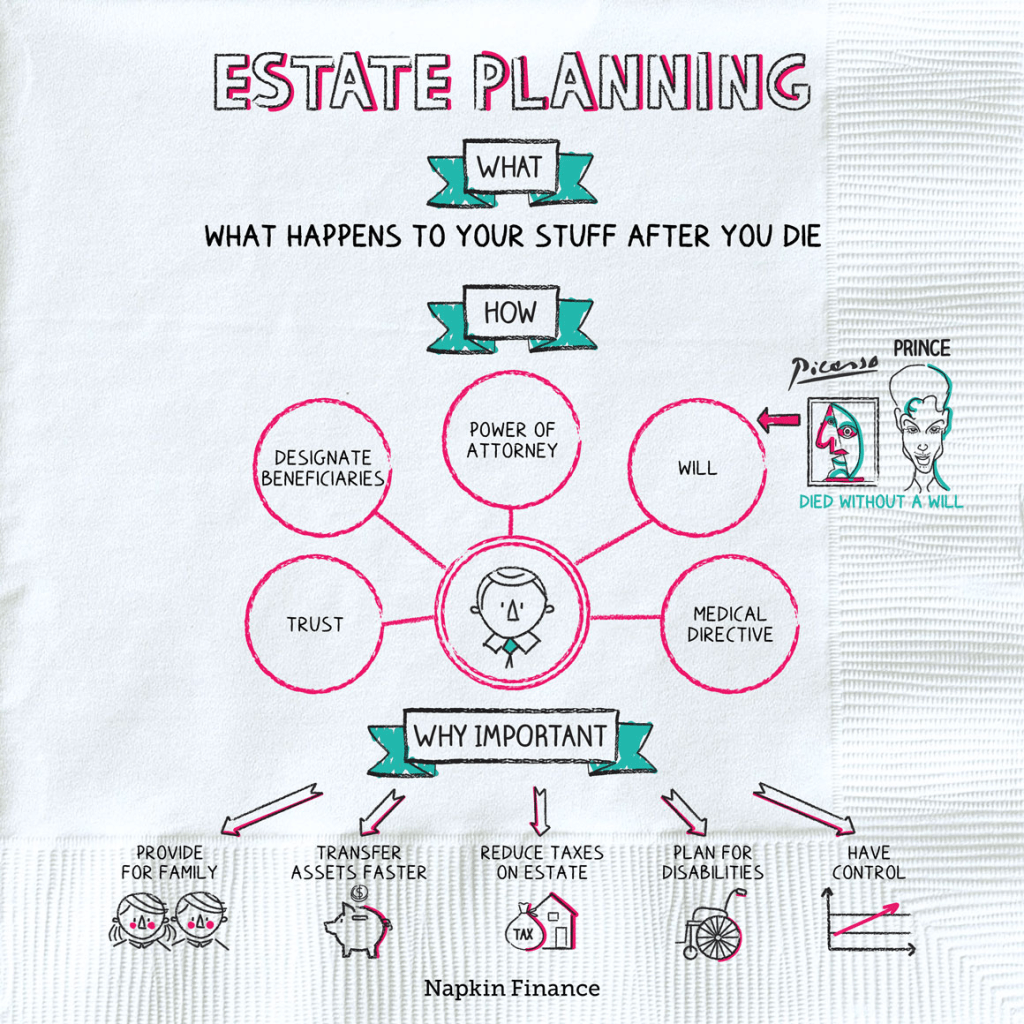
Estate planning is almost always done with an attorney. The main goals are to ensure your money goes where you want, your beneficiaries and heirs aren’t saddled with an unexpected estate tax or gift tax, and your assets are invested based on your wishes and associated timelines.
A will (plus guardianship) states how you wish to distribute your assets and what will happen to your dependents/children after death.
A power of attorney gives legal rights to another person to handle your non-health, non-medical affairs.
An advanced healthcare directive states your medical preferences if you become incapacitated, while designating someone else to make medical decisions for you.
Trusts are a three-party fiduciary agreement. The Trustor/Grantor has assets they give to the Trustee rights to hold the assets on behalf and for the benefit of the Beneficiary.
Steps to take for estate planning:
Inventory all of your assets and debts. What do you own and what do you owe?
Ensure you have life insurance for any dependents or your spouse.
Identify a guardian for your children or pets (if you have any).
Establish your will, a power of attorney, and an advanced healthcare directive.
Name your beneficiaries. You will need to do this for all financial accounts, IRAs, 401ks, life insurance, etc.
Notify your guardians and executors.
Keep the documents safe. Store a copy of your estate plan in a safe place. Review and update your estate plan at every major life event and at least every 5 years.
This past week I finished reading “The 5 Languages of Appreciation in the Workplace” by Gary Chapman and Paul E. White. Dr. Gary Chapman is the #1 New York Times bestselling author of “The 5 Love Languages.” Dr. Paul White is a psychologist, author, speaker, and consultant who helps make work relationships work. This book was very intuitive and fascinating! Here are some main take-aways:
The number one factor in job satisfaction is not the amount of pay but whether or not the individual feels appreciated and valued for the work they do.
The question is not “Do you appreciate your coworkers?” The real question is “Do they feel appreciated?”
Here are five languages of appreciation and ways to show them in the workplace:
words of affirmation – giving praise for a specific task, verbally affirming positive character traits, sending an e-mail with kudos, telling others about the good job someone is doing, writing a handwritten note of appreciation, or giving encouragement
quality time – quality conversation/shared experiences/small group dialogue/working in close proximity with coworkers, going to lunch together, checking in with people to see how they’re doing, taking a walk together, getting together for a sporting event
acts of service – asking before you help and doing it their way/clarifying how they want it done, serving voluntarily and completing what you start
receiving gifts – ask questions about interests (sports, restaurants, spas, theatre, etc.) and give a gift related to their interests
physical touch – handshakes, fist bumps, high fives, pats on the back
To figure out others’ language of appreciation, observe their behaviors, observe what they request of others, and listen to their complaints. The things about which an individual complains may reveal their primary appreciation language.
Be aware of your potential blind spot. The language of appreciation least valued by you will seldom be spoken. When a colleagues’ least important language of appreciation is words of affirmation, no matter how much you offer praise to them, it misses the mark.
Primary languages of appreciation may vary significantly over time in response to different life events, life stages, and the individuals with whom they are interacting.
I look forward to reading, learning, and sharing more with you soon!















 Read Learn Share