I read six books in November, some of which were short and easy reads. Here is a blurb of each of the books I read in November.
“Where I Dry the Flowers” is a Button Poetry book of poems written by Ollie Schminkey, a non-binary transgender poet and artist who has spent the past decade coaching, mentoring, teaching classes, and running workshops for poets. Many poems in this book are about grieving the loss of a complex person. I highly recommend this book to anyone who loves poetry and/or is trying to process grief. Here are some lines I enjoyed from this book.
Controversial opinion: In Defense of Speaking Ill of the Dead – “he is both: the man who would make us smoothies out of orange Kool-Aid and vanilla ice cream and the man who yelled when he drank and drank so often I’d run to the basement and lock the door.”
“I think grief is always at least two things: one, the constant realization that your expectations for the future were wrong, and two, death has happened and it will again.“
Forgiveness poem – “i never said it out loud. Maybe my father wanted forgiveness as much as I wanted an apology, but we stayed silent, the grudge, smooth as a pearl underneath our tongues. but it doesn’t mean i didn’t forgive him. and it doesn’t mean he wasn’t sorry . . . . when he offered me his death as an apology, i took it. of course, i took it.“
One of my favorite poems from the book is this one. I love the idea of contrapuntals.
4 out of 5 stars
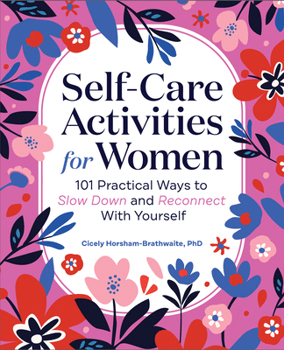
“Self-Care Activities for Women: 101 Practical Ways to Slow Down and Reconnect With Yourself” was a quick, easy read with excellent ideas from Cicely Horsham-Brathwaite, PhD, a licensed counseling psychologist and coach with over two decades of experience. This book provided different ideas for self-care in different categories: emotional, physical, mental, social, and professional. I highly recommend this book for anyone looking for self-care ideas. Here are some of my favorite ideas from each category.
Emotional self-care: Create your joy playlist. Create a list of songs that bring about positive memories and feelings, and schedule time in your calendar to listen to the entire playlist without multitasking whenever you need a mood shift.
Physical self-care: Plan a hike and picnic outdoors with friends.
Mental self-care: When you find yourself engaging in distracting behavior, reflect. What do I need right now? Is this giving me what I need, or do I need something else? Ex: may need a shower, hydration, exercise, rest, a hug, a good cry, journal reflection, or a talk with a friend.
Social self-care: Schedule activities with people you’d like to get together with on a regular basis. Rotate hosting.
Professional self-care: Establish a morning routine to set the tone for the rest of the day.
Self-care = “the actions one takes on their behalf in service of their well-being. Self-care means giving the world the best of you instead of what is left of you.”
5 out of 5 stars
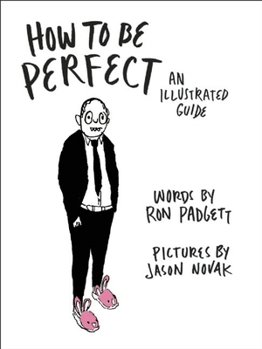
“How to Be Perfect: An Illustrated Guide” was a quick, fun, simple book written by Rod Padgett and illustrated by Jason Novak that took me under fifteen minutes to read. Here are a handful of my favorite lines.
Hope for everything. Expect nothing.
Be skeptical about all opinions, but try to see some value in each of them.
Learn something new every day.
Be honest with yourself and diplomatic with others.
Be on time, but if you are late do not give a detailed and lengthy excuse.
4 out of 5 stars
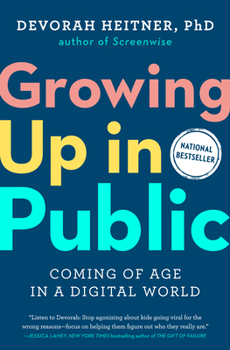
“Growing Up in Public: Coming of Age in a Digital World” was written by Devorah Heitner, PhD, who has spoken and written widely about parenting and growing up in the digital age. This book was interesting and thought-provoking, and I highly recommend it for all parents or anyone who hopes to be a parent someday. This review sums it up:
“A must-read for every parent. Emphasizing the importance of our children feeling seen instead of watched, mentored instead of monitored, this book is all at once a road map for preventing digital problems, a resource for what to do when things go wrong, and a crash course in how to empower our kids to become responsible, independent, and thoughtful digital citizens.” – Tina Payne Bryston, LCSW, PhD, NYT bestselling author of “The Whole Brain Child”
I got a lot out of this book, and here are just some of the tips:
Mentoring is better than monitoring if we want to set our kids up for success. We want our kids to make good decisions, even when we are not right there.
We need to do a better job of mentoring kids on how to be intentional about how much they share both online and offline.
Common mistakes from teens and kids: carelessly taking a video of themselves making a crude hang gesture or using profanity, sharing videos of themselves making an unkind joke about a peer or teacher, taking selfies of vaping/drinking/drugs, taking a video mocking someone’s disability, wearing a racist Halloween costume, making fun of someone’s accent or body type, and liking or reposting problematic things.
5 out of 5 stars
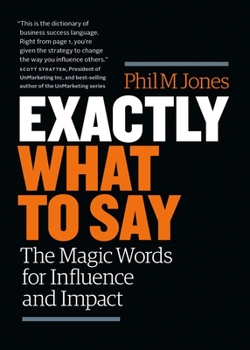
“Exactly What To Say: The Magic Words for Influence and Impact” was written by Phil M. Jones. This book can be considered a masterclass in the art of influence, persuasion, and generating top-producing results. This book often came across as salesy – teaching the world to sell. I highly recommend this book to anyone in sales or anyone who wants to influence or persuade others.
Here are some of the tips:
One of the biggest reasons your ideas fail to get heard is that others tell you that they just don’t have the time to consider them. By using the preface, “When would be a good time to . . .?” you prompt the other person to subconsciously assume that there will be a good time and that no is not an option.
The words, “As I see it, you have three options” help the other person through the decision-making process and allow you to appear impartial in doing so. Present your option last and as the easiest. Then ask “What’s going to be easier for you?“
“What happens next is . . . ” brings people through to the completion that needs to follow. It is your responsibility to lead the conversation, and following the sharing of the required information, your role is to move it toward a close.
Success in negotiating is all about maintaining control in a conversation, and the person in control is always the person who is asking the questions. Challenge objections with “What makes you say that?” This shift of control now leaves the other person obligated to give an answer and fill in the gaps in their previous statement.
5 out of 5 stars
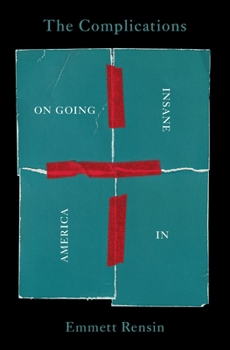
“The Complications: On Going Insane In America” was written by Emmett Rensin, who reflects on his life with schizoaffective disorder of the bipolar type: the hospitals and medication, the lost jobs and friends, the periods of mania and psychosis, the medication-induced tremor in his hands, etc. This book elevates the conversation around mental illness and challenges us to reexamine what we think we know about a world where one in a hundred people go mad. I learned a lot from this book and highly recommend it to anyone who wants to learn more about mental disorders. Here are some of my takeaways:
Some psychotic disorders become milder with age. Others are deteriorating, progressive conditions. Outcomes are difficult to predict.
The causes of severe psychiatric dysfunction are not thoroughly understood, but it is widely perceived that genes are not enough. Some additional event typically precipitates the full break. Trauma, substance abuse, and brain injury are common suspects.
It takes 7-8 years, on average, after initial onset of symptoms to get a diagnosis.
While brain abnormalities exist in some psychiatric patients, there are no consistent organic “signs” of madness, not any biological test for any psychiatric pathology.
“In between the positive exclamations of a psychotic disorder – bouts of delusion, mania, hallucinatory experience – are the dull murmurs of what we call negative symptoms, which generally include a blunt affect, social isolation, difficulty feeling pleasure, a lack of willpower, and poverty of speech.
“One of the greatest predictors of patient prognosis in the case of psychotic disorders is the degree of patient insight, which is to say, the degree to which the patient is aware of their disorder. If you cannot believe that you are ill, then you are unlikely to take your medication. If you do not take your medication, your condition will worsen. If your condition worsens, you are no more likely to take your medication or engage in the tedium of self-care.”
This reflection from the author stood out to me:
I am afraid of reaching a point where I do not want help, do not believe that I need help, where I run away from anyone who tries to help me, or worse, where I become so terrified or angry or violent that I hurt those people until they are not willing to help me anymore. I am afraid that one day I will become so sick that I reach the end of other people’s charity.
4 out of 5 stars – at times, this book was difficult to read and seemingly consisted of tangents and ramblings – however, this was likely due to periods of mania.
4 out of 5 stars
I look forward to reading, learning, and sharing more with you soon!
My intention is to post a Thoughtful Thursday column each week and share some of the insights I have learned in the past week. Here are some of the things I’ve learned this week:
Sad to Savage- Habits I Do On Vacation & Reflecting on Turning 26
In this episode, Shelby was reflecting on turning 26 and asked herself these reflection questions. I think these are great for anytime, especially for a personal growth mindset!
Ask yourself:
Who is she?
What does she say to herself?
How does she describe herself?
What does her day look like?
What are her daily habits?
Where does she live?
What does she do for work?
What does her work day look like?
What makes her feel good?
When does she work out?
How does she view nutrition?
Who does she surround herself with?
What are the daily choices that she makes?
What are the choices that she makes on the weekend?
What is she doing to get 1% better?
What is her favorite way to habit stack?
What is her morning routine?
What is her nighttime routine?
What is she working towards?
What are her top 3 goals, and what are 3 daily habits she can do to help her work towards those goals?
What is one area she wants to improve in?
Mental Performance Daily- How Are You vs. What Are You?
Instead of asking yourself how you are doing, ask what you are doing. What should I be doing right now? What is the best use of my time, energy, effort, and focus right now? How I am doing is hit or miss, up and down as part of the human condition. Asking yourself what you are doing is going to help you perform at an elite level; comparing what you are doing vs. what you should be doing.
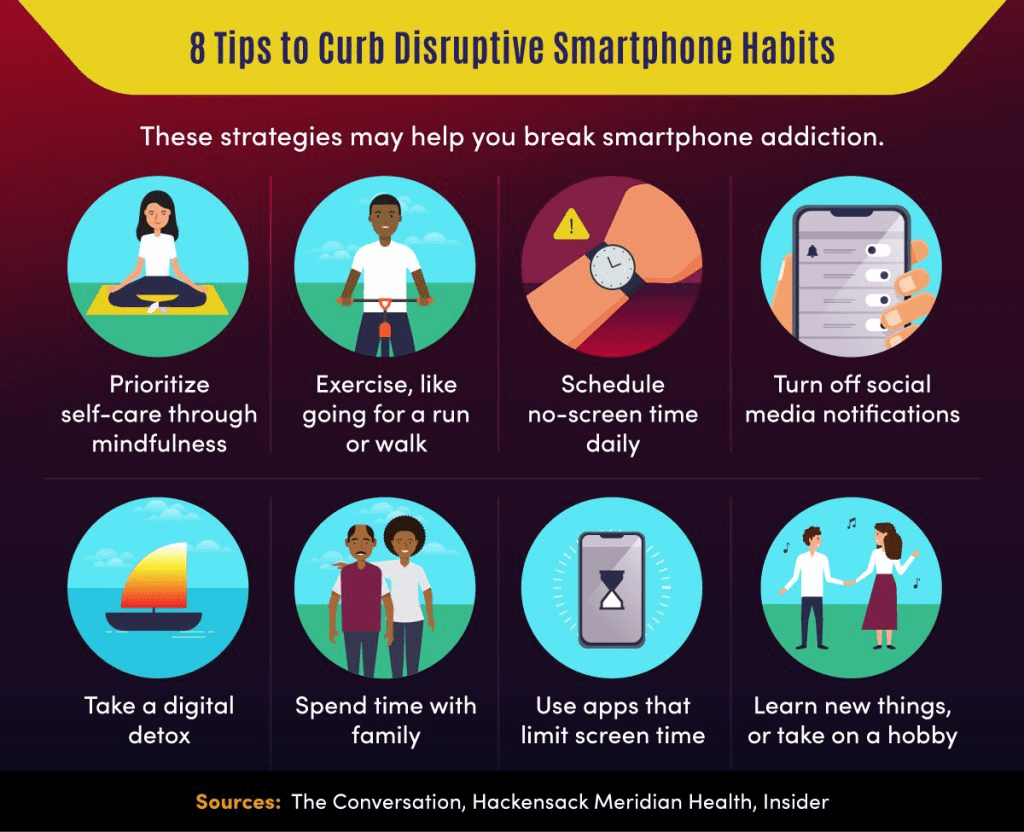
Optimal Living Daily- Breaking the Dependency to My Phone by Mollie of This EverGreen Home
Use social media less frequently. Set a daily time limit. You can use apps to limit your screen time.
Check e-mail at designated times.
Track your app usage.
Find a home base for your phone so it isn’t always next to you.
Turn off notifications.
Begin a new behavior. Ex: instead of browsing on your phone, read a book.
Turn on do not disturb.
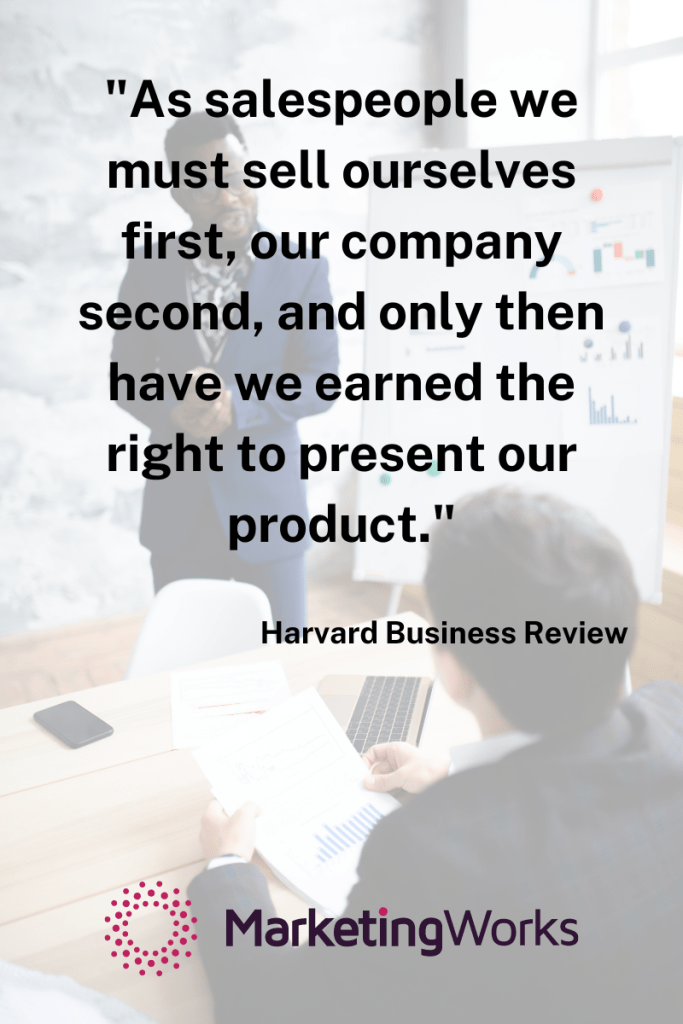
How to Be a Better Human- What we can learn from great salespeople (w/ Colin Coggins)
Everyone is either selling an idea, themselves, or a product or a service.
The greatest sellers on the planet create agency with the person they are speaking with so that they feel like they are part of the decision-making process.
Acknowledge what’s happening in real life. That’s what sales is about.
You want people to look for the good in you and believe in you. That doesn’t happen unless you can reciprocate that.
Realize that who people hope you are and who people expect you are are two different things. People hope you’re like them.
The next time you go into a meeting, spend three minutes thinking about three things that you could love about this person.
What you get paid to do and what you love doing aren’t always the same thing, but a lot of times there are areas in what you get paid to do that you do love – like the stuff you would do for free. Isolate what you love. See if you can delegate or avoid the things that you don’t love.
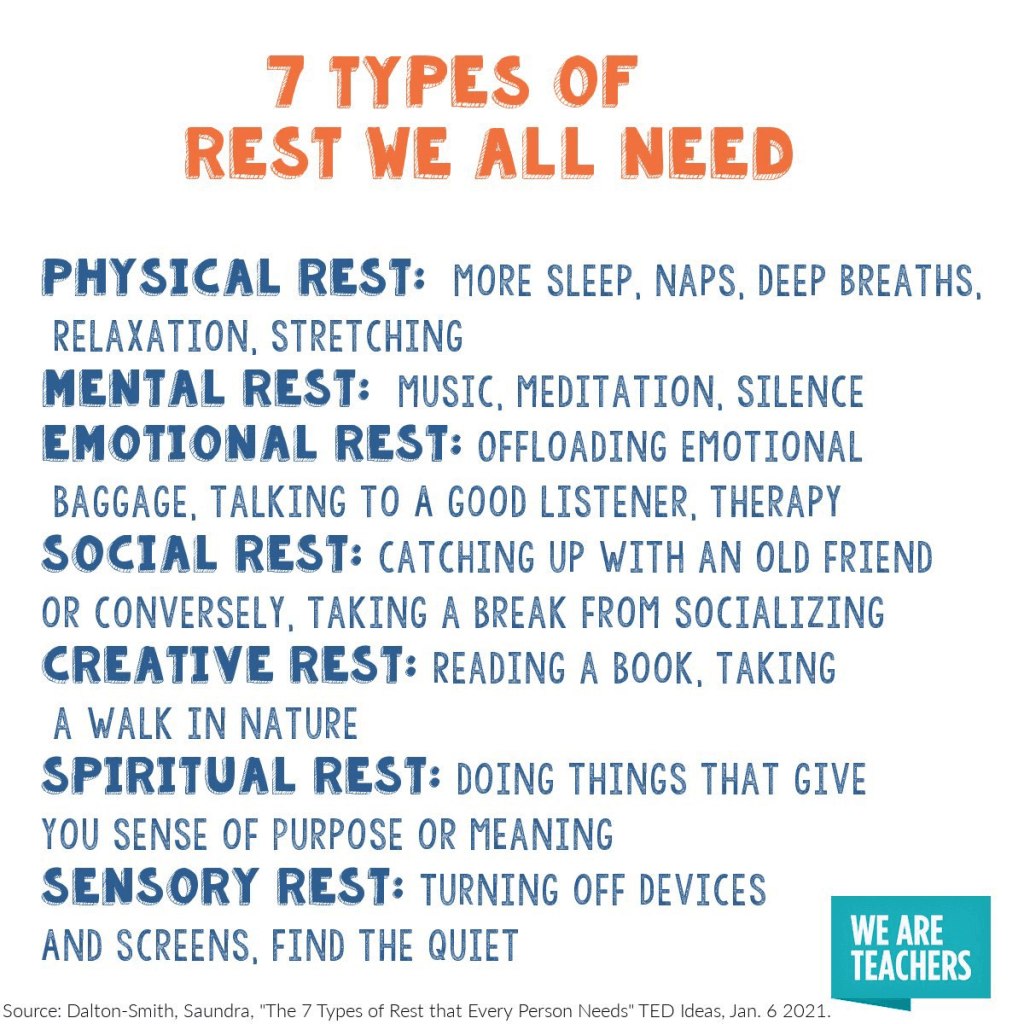
The Savvy Psychologist- 7 types of rest you’ve been missing
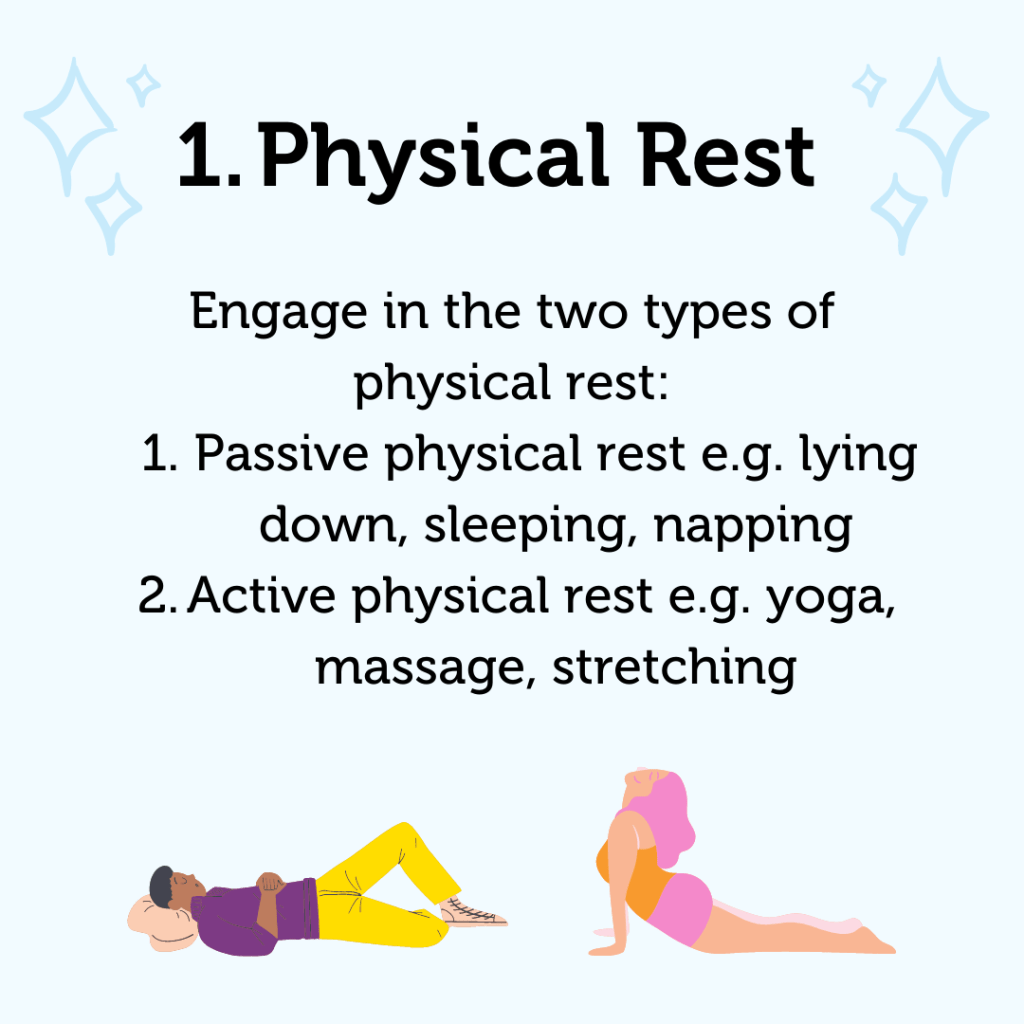
Physical rest (passive and active)– sleeping, napping, FOLLOW A SLEEP PROTOCOL/EVENING ROUTINE, stretching, yoga, breathing exercises, progressive muscle relaxation, hot baths, massages. Watch out for signs that you need physical rest, such as lacking energy to make it through the day, feeling tired but having difficulty falling asleep, reliance on substances to give you energy, and depending on substances to give you more rest.
Mental rest– mental fatigue can result from a variety of things, including negative self-talk, rumination, anxious what-if thinking, being stuck in the past, and judgments. Signs that you may need mental rest include irritability and decreased frustration tolerance, avoiding activities, feeling like you’re in a mental fog throughout the day, and feeling overwhelmed by daily tasks. One way to ease the mental load is through good time management skills. Take into account not only the amount of time a task takes, but the emotional load it takes as well. Another way to give yourself mental rest is through meditation.
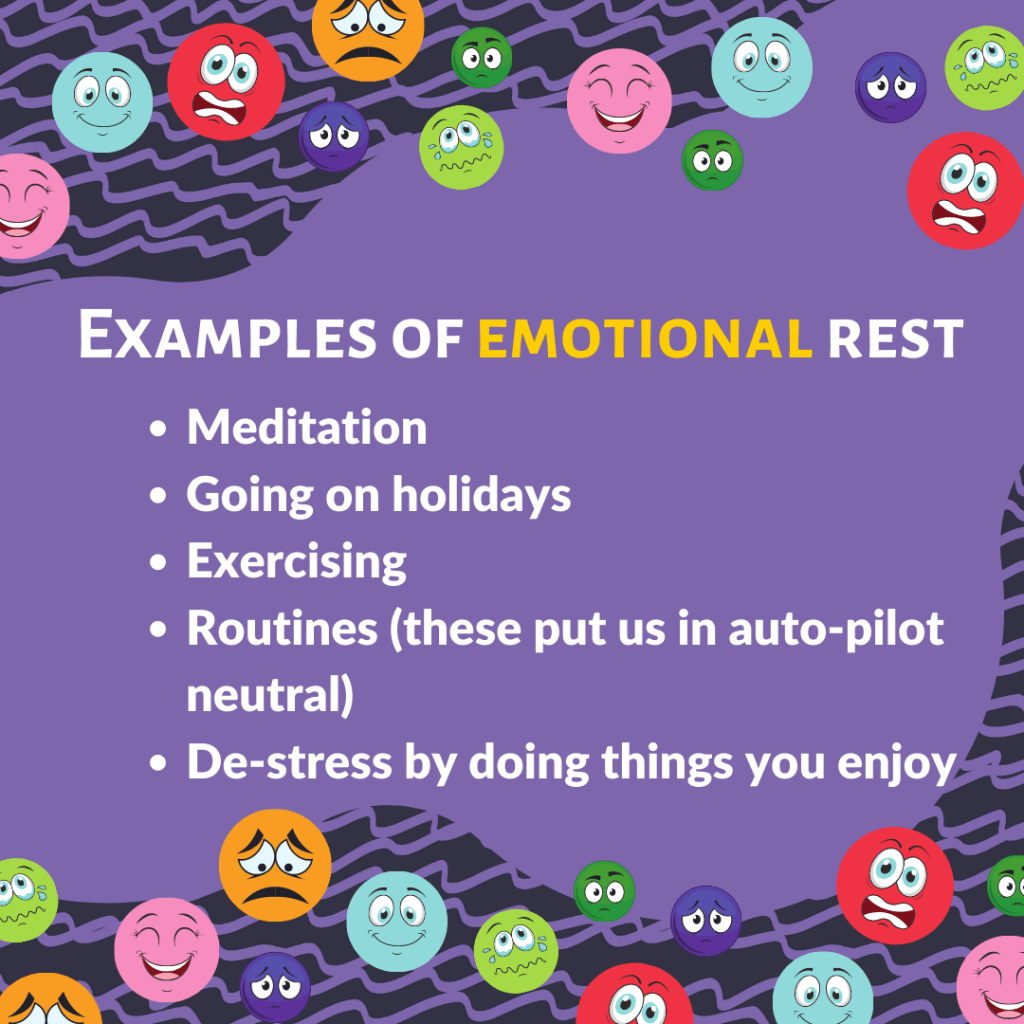
Emotional rest– where are you spending your emotional energy? Frustration, anxiety, inadequacy, sadness, annoyance, etc. Some signs you may be experiencing an emotional rest deficit include beating ourselves up for small mistakes, excessive worry or anxiety, feelings of self-doubt, and over apologizing. Be mindful of your environment and the things/people that drain you and restore you. Emotions are contagious. Modify your environments the best you can. Emotional awareness is key to identifying emotional drains and emotional restores. Reduce the amount of social comparisons that you do.
Spiritual rest– organized religious practices, connecting with something greater than yourself, prayer, feeling a sense of belonging by getting involved with your community, meditation, things that bring you a sense of purpose and make you feel connected
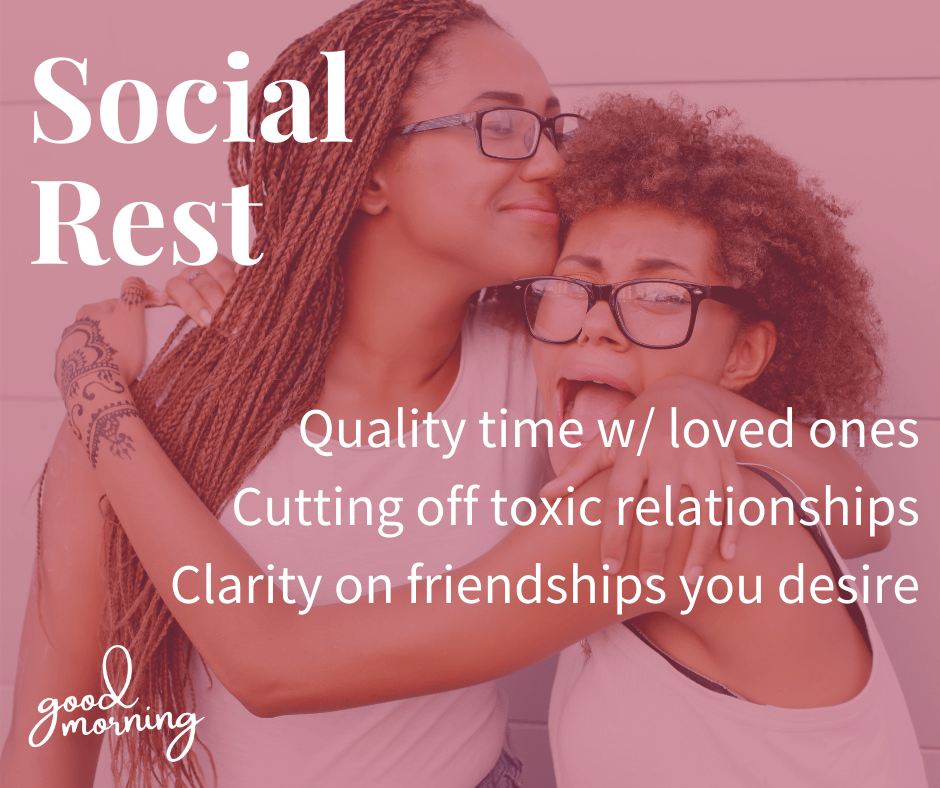
Social rest– A social rest deficit occurs when we fail to differentiate between relationships that restore us and relationships that drain us. It can also occur when we are engaging in too much or too little social interaction. Signs you have a social rest deficit include feeling alone, feeling detached, finding it hard to maintain close relationships, isolating from others, or finding that you are attracted to those that mistreat you. Identify your social needs. If you are introverted and have a customer-facing job, allow yourself alone time to recharge at the end of the day. Listen to your social needs and stop comparing yourself to others. Be present and show up in your social networks. This will aid in deepening relationships and feeling more connected. Find like-minded individuals who share some of your hobbies. Join a group.
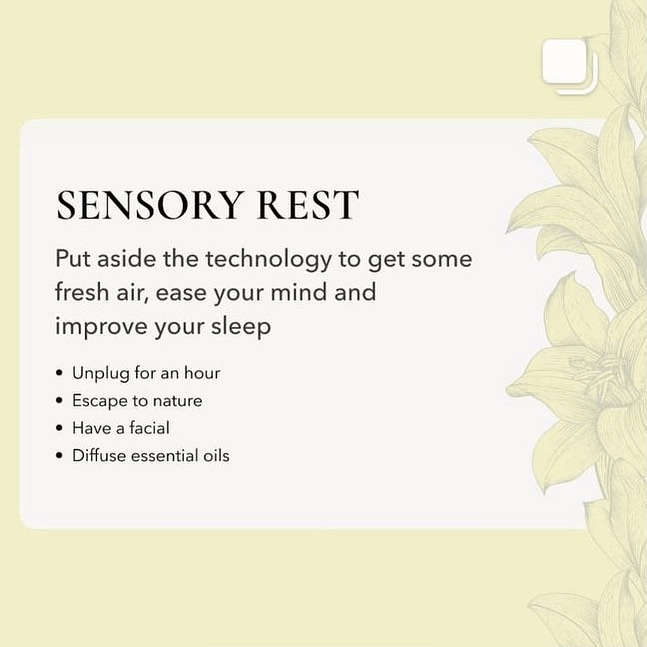
Sensory rest– giving your senses a break- overwhelming senses with constant stimuli. Spend some time away from your electronics. Read a physical book instead. Turn off the lights. Listen to your senses and give the ones that appear agitated a break.
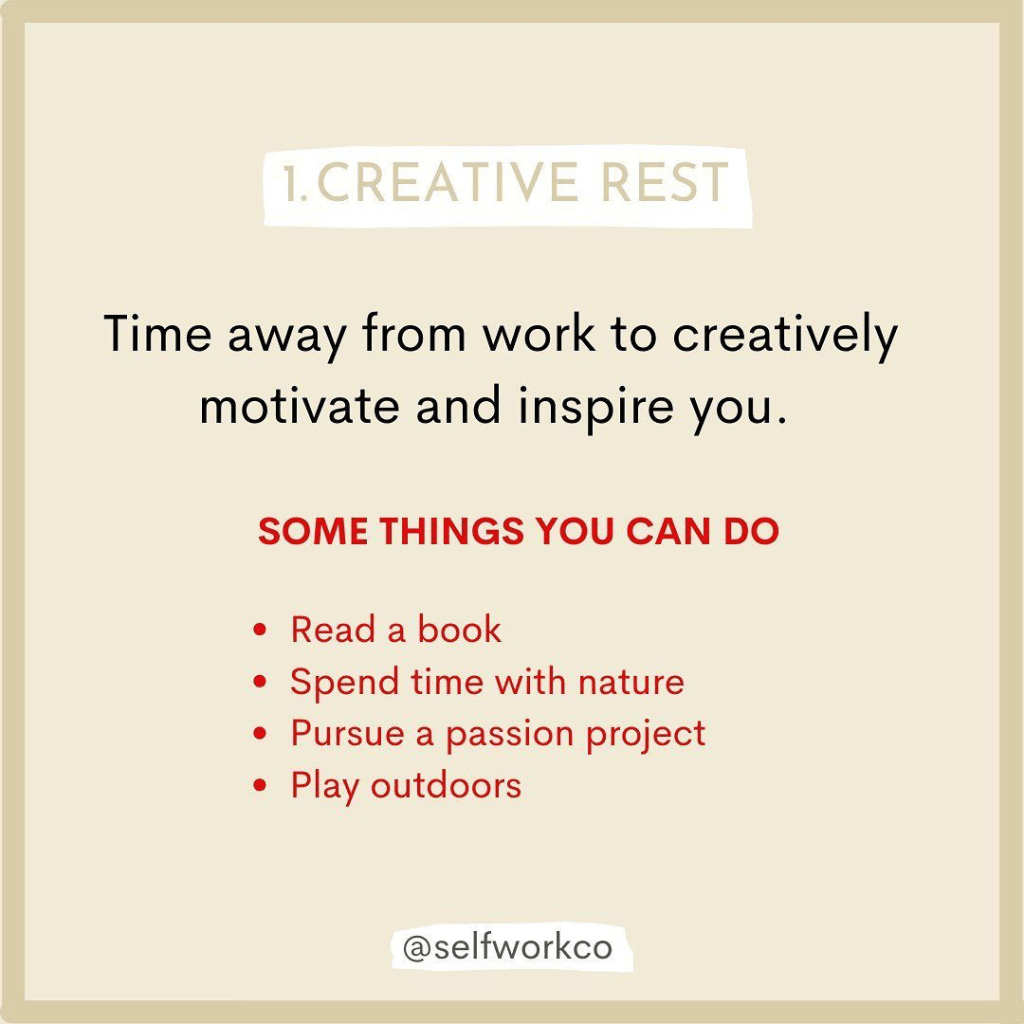
Creative rest– if you’ve ever felt like you’re out of good ideas, you’ve experienced being creatively drained. Creativity is about our ability to be innovative, think outside the box, or be inventive. People require creative rest when they feel stuck, uninspired, and unable to generate new ideas or solutions to problems. The key here is to remove the requirement to produce and get involved with activities that inspire you. Make time for the things you don’t normally make time for to refill your creative cup.
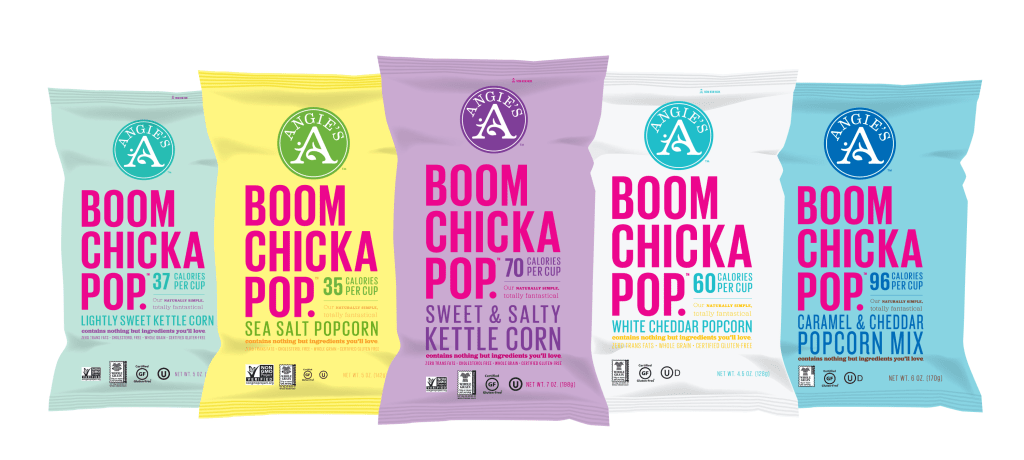
How I Built This with Guy Raz- Angie’s Boomchickapop: Angie & Dan Bastian
I was eager to learn more about Angie’s Boomchickapop, as their sweet and salty kettle corn is my favorite store-bought popcorn!! They also originated in my home state of Minnesota.
Beginnings:
Neither Dan nor Angie ever had a particular love for popcorn initially. They needed a way to earn extra money to save for their kids’ college funds, and popping and selling kettle corn seemed like a reasonable way to do it. In 2001, after Dan saw an internet ad for kettle corn equipment, he convinced Angie that they should go for it. They started in their garage in Mankato, Minnesota.
They bought a kit using a 0% interest credit card. The kit included a tent, outdoor kettle, and table and paid $8k or $10k. Of note, the kit did not have instructions!
Dan was working as a teacher and Angie was working as a nurse at the time.
Rainbow Foods was the first place that allowed them to sell it (in front of the door outside) in November 2001. They were limited because they had to pop outdoors due to propane with the kettle. They took 1 hour to set up, bagged using twist-tie bags, and sold $300 of kettle corn.
Their business was originally called Kettle Corn Café.
Coworkers and students were surprised to see them on the weekends with their kettle corn business.
Growth:
In 2002, they started to sell outside of the Minnesota Vikings training camp and gave some free popcorn to the players.
The players loved it, but Dan and Angie realized that they would need to pay for a sponsorship fee to be the Minnesota Vikings’ preferred popcorn! They paid an $8k sponsorship fee.
Dan quit his job in 2003 after 2 years in the business to focus on the popcorn business.
Lunds and Byerlys was interested but wanted them to get their act together for selling. They needed to find a facility, different packaging, etc.
They bought a small kitchen 6 months later and moved operation indoors, got the kitchen licensed, and launched 6 months later with a new brand name: Angie’s.
They found 2 retired teachers willing to help out and paid $8 an hour for BOTH of them.
Challenges:
During their first 7 years, they were buried further and further into debt.
They weren’t profitable at first. They used funds to buy a trailer, a heater, and other items. Everything seemed to go back into the business.
In 2008, they had to get a million-dollar loan to get a bigger facility to ramp up production. They had debt and didn’t really have collateral and were turned down for a loan by many banks. They had about 20 employees at the time.
They eventually found a partner who gave them a line of credit using personal guarantees (home, future earnings – everything but the mini van).
Expansion:
In 2008, after years of persistence, they got into Trader Joes after sending products to a contact. Trader Joes put in an order for 25 trucks ($500k worth) that would be distributed across the country to Trader Joes. Jon and Angie didn’t have enough money to buy the materials for this order, so they ordered a new credit card with a $100k line of credit and requested an immediate wire transfer!
Due to popularity, Trader Joes came back with another order of 25 truckloads. The business needed to scale up quickly and hire more people.
In 2009, revenue was $3-$4 million.
In 2011, outside investment firm, Sherbrooke Capital, made an offer and acquired a majority stake in Angie’s.
In 2011, Angie’s was in the natural and organic snack section in Costco, Target, and regional grocery chains and was doing very well. Angie’s started with kettle corn but wanted to expand through providing different flavors, messaging, and branding.
Dan’s cell phone was on every package because that was the business phone and he received several phone calls at all hours asking if the product is gluten-free. So they decided to get certified gluten-free.
Also in 2011, they went to a branding agency to come up with a new name. Boomchickapop, the new name, launched in 2012. It was the first non-GMO branded popcorn on the market. The yellow bags of sea salt popcorn were the #1 selling SKU in four months – after 9 years of business.
$$$:
In 2014, TPG Growth, a private equity firm, bought out Sherbrooke. Boomchickapop equity shares became liquid to staff. They distributed millions of dollars! Between 2014 and 2017, Dan and Angie sold a big share of their ownership to TPG Growth.
In 2017, 16 years after the business started, ConAgra bought out Boomchickapop for $250 million! When ConAgra bought the company in 2017, they also acquired the old kettle originally bought in 2001.
They never imagined they would make it that far with their initial investment.
I look forward to reading, learning, and sharing more with you soon!









 Read Learn Share