I read four books in March 2024. I have been reading less for my personal pleasure due to being busy with a post-graduate paralegal certificate program and spending most of my time reading textbooks. Here is a brief synopsis of the four books I read in March 2024, some of which I will post about in greater detail in the future.
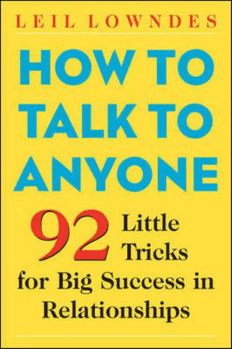
“How to Talk to Anyone: 92 Little Tricks for Big Success in Relationships” was written by Leil Lowndes, an internationally acclaimed communications expert who coaches top executives of Fortune 500 companies and frontline employees to become more effective communicators. Leil conducts communications seminars for the U.S. Peace Corps, foreign governments, and major corporations. While I did learn some great communication tricks and the book was very useful, I did not like the phone and smug tone of writing. Here are a handful of my take-aways:
- When someone asks where you are from, never give just the city. Learn some engaging facts about your hometown that conversational partners can communicate on.
- Never give a naked thank you. Never let the phrase “thank you” stand alone.
- If you leave a voicemail, view it as your ten-second audition to prove you are worthy of a quick callback.
- Use the big baby pivot when you meet someone new. Give the warm smile, the total-body turn, and the undivided attention you would give a baby who crawled up to your feet and smiled at you.
- Imagine a giant swiveling spotlight between you and your conversation partner. The longer you keep it shining away from you, the more interesting he or she finds you.
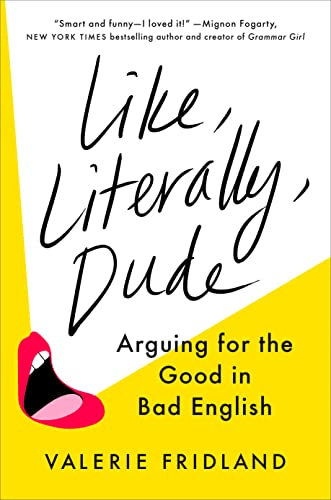
“Like, Literally, Dude: Arguing for the Good in Bad English” was written by Valerie Fridland, a professor of linguistics at the University of Nevada and author of the popular language blog called “Language in the Wild.” This book contained a linguistic exploration of the speech habits we love to hate – linguistic quirks that are fundamental to our social, professional, and romantic success. This book was fascinating, and here are just a few facts that resonated with me:
Language evolution doesn’t happen in a vacuum. Language evolves because social forces act as triggers in taking underlying linguistic tendencies and giving them social meaning. Ex: migration, school, class, cultural shifts, geography, age, etc.
‘Ums‘ and ‘uhs‘ don’t just fill pauses- these words unconsciously signify the introduction of a new topic or a complex idea and signal to a listener that there will be an upcoming speech delay and convey how long of a delay the listener should expect. ‘Um‘ precedes longer delays than ‘uh.’ They also result in a boost in memory to the listener (of what was stated after the pause) and filled pauses buy ourselves processing time and convey to the listener that “it’s still my turn.”
Our unease with the use of the word ‘like‘ is probably more about its association with casual, younger speech than its functionality. ‘Like‘ is an incredibly amorphous word:
- verb – to discuss fondness for objects or people
- noun – to describe likes and dislikes
- adjective – to mean similar to “in the manner of”
- preposition – simile construction
- conjunction – to embed another clause
- approximating marker – looseness of meaning before a numerical estimate/quantification
- common quotative verb
“100 Ways to Change Your Life: The Science of Leveling Up Health, Happiness, Relationships, & Success” was written by Liz Moody, the host of the top-rated Liz Moody podcast, author of best-selling books, and popular online content creator. This book was my favorite book I read in March and contained so much valuable information! I will post about this book in more detail another time, but in the meantime, here are five ways you can change your life.
- Take the risk. You are far more resilient than you think. Doing is a form of figuring out. Just start. The right time is always right now. A fundamental reason many people don’t find success is that they never begin.
- Think about your death. What can it highlight about living a life that you’re proud of today? What can it teach you about shifts you need to make?
- Establish and stick to better boundaries. You reclaim your energy, time, capacity, money, and physical space. We begin to resent people for not catering to our needs, even when we’ve never communicated what those needs actually are. Take a pause before replying to anyone’s invitation or request. Practice checking in with yourself first before you tend to someone else’s needs.
- Identify your financial dreams. Why do you want to accumulate wealth in the first place? What is your Rich Life? What do you value? What are some things other people might value that truly don’t matter to you? Spend your money on what you value.
- Create a mental health checklist. Social connection, good nutrition, routine, sleep, and movement are the five pillars of mental health. Use them as a first line of answers if you aren’t feeling your best.

“Excuse Me As I Kiss The Sky” was written by Rudy Francisco, one of the most recognizable names in spoken word poetry, and one of my favorite poets. This book covered different poetry styles, some of which I am not familiar with: ode, obit, golden shovel, contrapuntal, question-and-answer, free verse, page to stage, and love poems.
Rudy is one of the most recognizable names in spoken word poetry, but his talent also shows on the page. Rudy mentioned the difference between page poems and performance poems. Page poems are written for visual aesthetics and consist of rearranging text and line breaks. Performance poems are focused on how the poem will sound out loud, how it feels to say the words, the syllable count, rhythm, and taking just one chance to explain the story.
Here are some of my favorite lines in the book, which I have not formatted into the page poems:
Fragile – “I know the heart can be a fragile and dangerous thing. When it breaks, the ends are often jagged and will cut the hands of people who are just trying to help you clean up the mess. But I also know that pain is nomadic. It doesn’t like to stay in one play for too long. Healing is a slow crawl, but it will find you right where you are.”
“Fear is when we turn up the volume on everything that might go wrong and then allow it to speak louder than courage.”
“The past is one of the few things more stubborn than we are. It will not change and doesn’t care if you have a better idea of how the story should’ve ended.
Healing begins when we stop trying to run backwards on the escalator and embrace whatever will keep us moving forward.”
“I hope you stumble into the kind of love that bends all the question marks into exclamation points.”
I look forward to reading, learning, and sharing more with you soon!

 Read Learn Share