It’s been a while since I’ve posted on this blog since I have had other priorities. I read 5 books in April. Here is a blurb of each of the books I read in April.
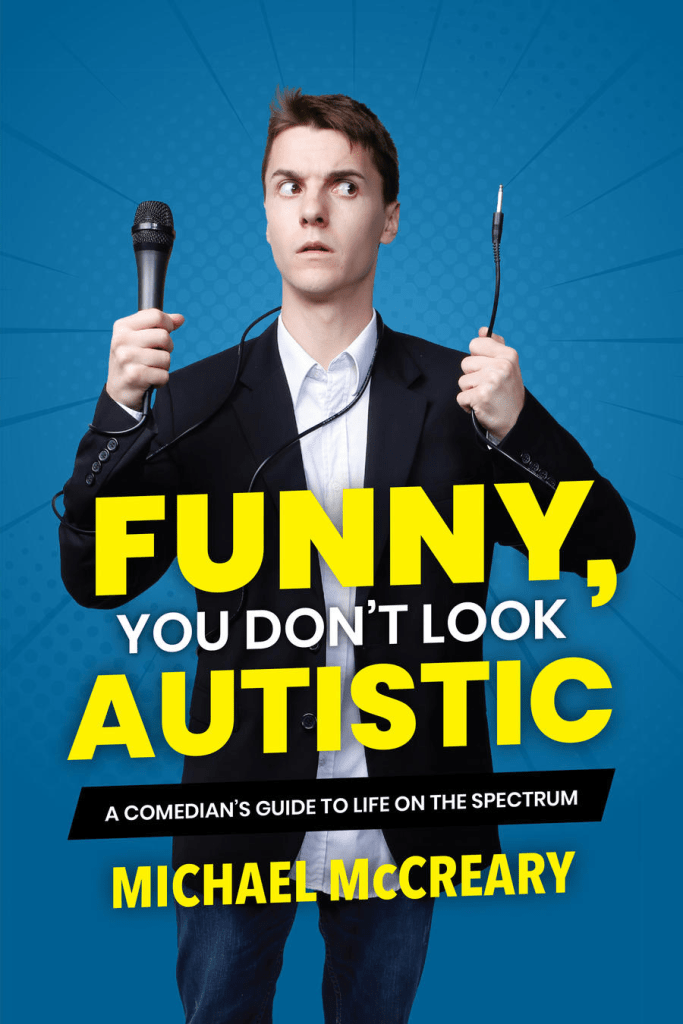
“Funny, You Don’t Look Autistic: A Comedian’s Guide to Life on the Spectrum” was written by Michael McCreary, who does stand-up comedy about being on the autism spectrum and uses comedy to help demystify autism and break down stereotypes. He has performed across North America and lives in Toronto, Canada. Although this is not a comprehensive educational book, I learned more about autism. Here are some takeaways.
Everyone with autism spectrum disorder (ASD) is different. People with ASD have many of the same thoughts and feelings as anyone else. The difference is in the intensity of those feelings and the degree to which they affect functioning.
The DSM-5 defines autism as a “triad of impairments” that presents challenges in these areas:
social interaction
communication
repetitive behaviors
Some people have heightened senses and can’t handle sudden bursts or noise or tags on clothes, while others are under-sensitive to sensory information and need to seek out stimulation. This is known as “stimming” and can include rocking, staring at lights, repetitive blinking, tapping, making sounds, spinning objects, rubbing your skin, clapping, or leg-shaking.
The author took improv classes. Improv requires you to listen to people, respond to them, and go with the flow: “Improv taught me more about social skills than any learning strategies ever could.”
When I’d seen comics lean on a mic stand, I always thought it was a power move. I soon realized that it was meant to make your shaking less obvious.
In media, the characters often seem like a checklist of symptoms rather than real people, a collection of quirks that have been mistaken for a personality. The problem with presenting autism on-screen is that it becomes the crux of the character. Having autism is a characteristic, not a character.
Although this book provided some useful information, it left more to be desired.
3 out of 5 stars
“The Unclaimed: Abandonment and Hope in the City of Angels” by Pamela Prickett and Stefan Timmermans is a powerful work of narrative nonfiction that explores what happens when people die with no one to claim them. Prickett, a sociology professor and former broadcaster, and Timmermans, a UCLA sociologist known for his work on death investigations, follow the lives of four individuals in Los Angeles who died between 2012 and 2019—some with family and means, others without—revealing how easily people can become invisible. Alongside their stories, the authors introduce us to the scene investigators, notification officers, and crematorium workers who step in when no one else will. I found the book deeply moving and full of surprising insights. Here are just a few that stayed with me.
Today, more and more relatives are abandoning their dead, leaving it to local governments to dispose of the bodies. Up to 150,000 Americans now go unclaimed each year.
The term of choice for those sent to the potter’s field is no longer indigent but unclaimed – reflective of relatives’ inability or unwillingness to take care of their dead.
There is no federal agency to track or oversee the unclaimed – just a patchwork of ad hoc local practices.
Los Angeles – “Over five hours, the men poured 1,461 boxes and envelopes into the grave – a year’s worth of ashes.”
Just because a family might be indigent does not mean a decedent is. To access a decedent’s $, the family needs a death certificate. The medical examiner’s office would not release the death certificate until the family hired a private funeral home to transfer the body from the crowded crypt. Quick access to the death certificate was one of the few carrots the office had to entice hesitant families to claim.
Meanwhile, even as they refused to claim David’s body, Mikel and Tiffany were planning how they would spend David’s money. When the estate was settled, after expenses and fees amounting to $30,000, Tiffany’s share came to $10,996.71. Feeling no shame about benefiting from the investment account of a man they hadn’t spoken to in decades, they decided to take a late honeymoon.
Patterns that increase likelihood of being unclaimed: social isolation caused by eroding family ties, never getting married, estrangement
I highly recommend this fascinating book! I learned so much about the unclaimed.
5 out of 5 stars
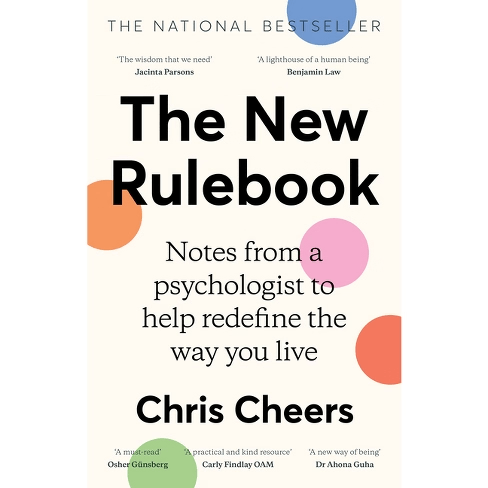
“The New Rulebook: Notes from a psychologist to help redefine the way you live” was written by Dr. Chris Cheers, an Australian psychologist and educator with a focus on elevating mental health in the arts and LGBTQIA+ communities. In this book, Dr. Cheers compassionately asks readers to examine 5 key areas of their lives: self-care, emotions, work, love, and body, and offers evidence-based solutions to redefine their lives not based on expectations of how they should live but led by what they need. Here are some reflections.
If you only focus on self, you start to view self-care as something that is a solo effort – something you buy for yourself, do alone, etc. Many of the worthwhile actions of self-care are carried out in relation to other people, such as communicating boundaries, saying no, or standing up for yourself.
We often recognize that we’re unhappy in our relationships, at work, or in daily life, but we rarely see major change as a real option. Instead, we try to feel better about the lives we already have and convince ourselves that change is too hard or simply not possible. In that process, self-care can become a soothing distraction rather than a solution. If your version of self-care is helping you cope with something that truly needs to change, it may not be care at all. It may be a quiet form of self-neglect.
Self-Care Reflection Questions
How can I care for myself today?
What are the barriers to making that happen? Can they be challenged?
What can I do to help make that care happen?
What positive impact will this care have not only for me, but for my community and the people in my life?
Values – How do you want people to describe you? What words do you want them to use to describe what you have held as most meaningful and important in your life? These are your values.
Values are useless if they just remain an ideal. Our daily actions become our life and identity. Consider how your actions have aligned with your values over the last six months and consider which behavior you could limit to make space for more meaningful actions.
We promote belonging in our relationships through intentional gathering. Safety comes from clear communication and trust. Trust is earned through actions that show accountability, integrity, and reliability. We can also promote a sense of safety in our relationships through learning how to have a difficult conversation, apologize, and come together after conflict.
I recommend this book to anyone who wants to examine the 5 key areas of their lives: self-care, emotions, work, love, and body.
4 out of 5 stars
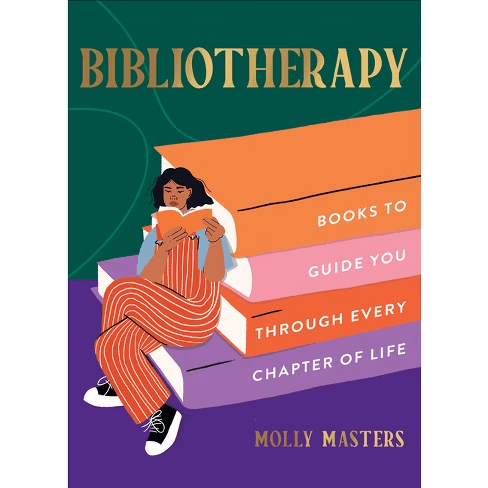
“Bibliotherapy: Books to Guide You Through Every Chapter of Life” was written by Molly Masters, a writer, podcaster, director and CEO of Aphra, and CEO of Bookshop Limited. Bibliotherapy is the application of literature towards a therapeutic goal. This book was a bibliotherapy concierge for confidence and courage, adulting, empowerment, first loves and great loves, heartbreak, self-love and self-discovery, LGBTQIA+ identity, new beginnings, new parents, creativity and inspiration, escapism, your mind, grief and loss, and feeling directionless.
This book was split into sections and provided one-sentence blurbs about most books recommended. I wrote several titles down to research more or read, and I highly recommend this book if you want book recommendations for the categories listed above! I will not be sharing titles recommended at this time because I don’t want to endorse books I have not read yet.
4 out of 5 stars
.
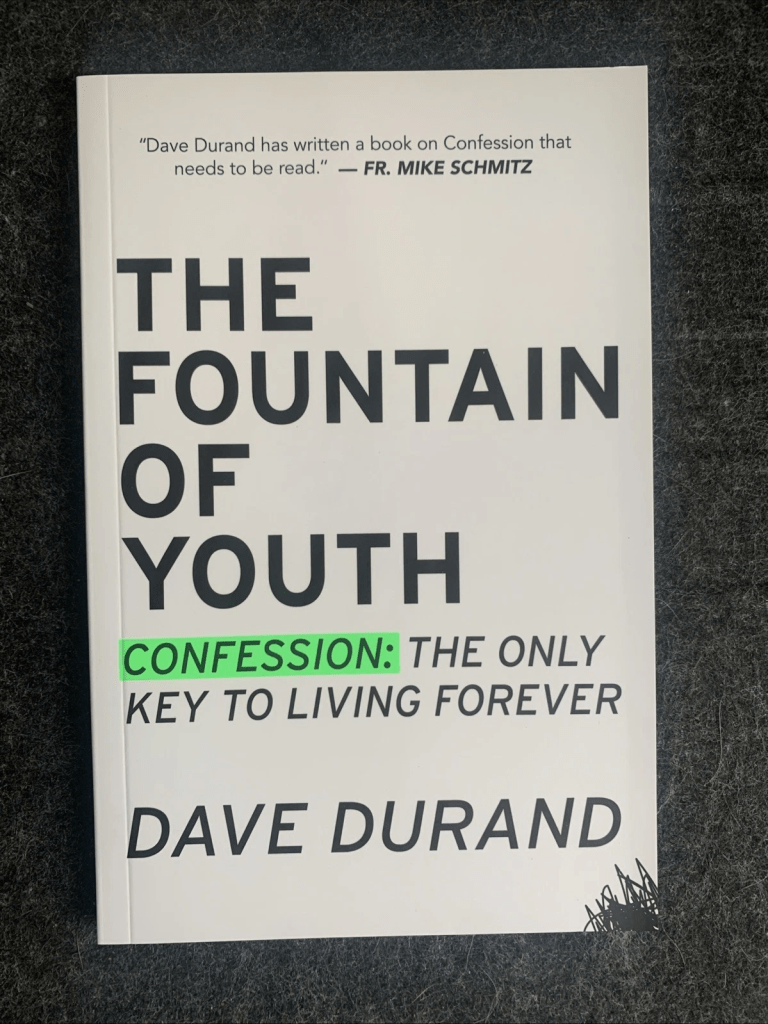
“The Fountain of Youth – Confession: The Only Key to Living Forever” was written by Dave Durand. This book was handed out by my Catholic church and explores a topic that many Catholics (and Christians in general) struggle with: the Sacrament of Confession. Dave Durand takes a direct approach, addressing common excuses people make for avoiding confession, and offering responses rooted in Scripture and Church teaching. Here’s a brief look at a few of those points:
“It is not necessary to go to a priest. I can just tell my sins to God directly.” Durand reminds us that Jesus gave His apostles the authority to forgive sins—a gift passed down through the Church.
“At least I’m not as bad as others.” The book challenges the idea that God “grades on a curve” and instead invites us to humbly acknowledge our need for grace, just as many saints once did.
Self-Justification Rather than justifying our actions, confession helps us confront our faults honestly before God, which can lead to deeper transformation in all areas of life.
“Who is the Church to say what’s a sin?” Durand addresses this with a reminder that moral truth doesn’t change based on opinion and that Jesus established the Church for guidance and accountability.
“I keep committing the same sin—what’s the point?” He encourages persistence in confession, noting that repeated sin doesn’t mean failure if we sincerely strive to grow in virtue with God’s help.
Emotional Blocks Past negative experiences can make confession difficult, but Durand gently urges readers not to let one painful moment keep them from God’s healing grace.
Overall, The Fountain of Youth offers a clear and convicting view of confession within the Catholic faith grounded in both Scripture and the Catechism. Whether you’re a lifelong Catholic or simply curious about the sacrament, it presents a perspective worth reflecting on.
4 out of 5 stars
I look forward to reading, learning, and sharing more with you soon!
I read four books in May 2024. Here is a brief synopsis of the four books I read in May 2024, some of which I will post about in greater detail in the future.
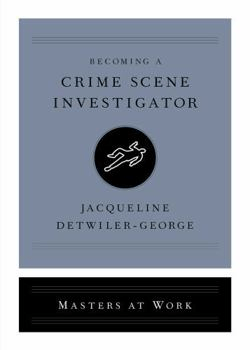
“Becoming A Crime Scene Investigator” by Jacqueline Detwiler-George was an interesting overview of crime scene investigation and forensic science. Here are some of the main points covered in this book:
This job has many names: crime scene investigator, evidence technician, forensic investigator, crime scene technician, crime scene analyst, and crime scene examiner.
The science part of crime scene investigation involves knowing how to collect evidence so that it can be analyzed and deployed in court and knowing what to grab at the scene.
Crime scene investigators do not perform all of the functions they are depicted handling on tv. It is different everywhere. Some police/sheriff’s departments have their own crime labs, while others send all evidence to regional or state labs for processing.
Crime scene investigators used to be generalists. Now they specialize. Forensic analysts often collect master’s degrees and professional certifications.
Most standard crimes can be solved with a combination of photography, DNA evidence, serology, fingerprints, ballistics comparison, drug chemistry, and computer forensics.
Less common: blood spatter analysis, trace evidence analysis, forensic anthropology, and questioned documents
A background in hard science and forensics can lead a person toward dozens of different exciting careers, such as forensic anthropology, veterinary forensics, mail crime, digital forensics, arson investigation, bomb analysis, medical and mortuary sciences, chemical warfare forensics, etc.
4 out of 5 stars
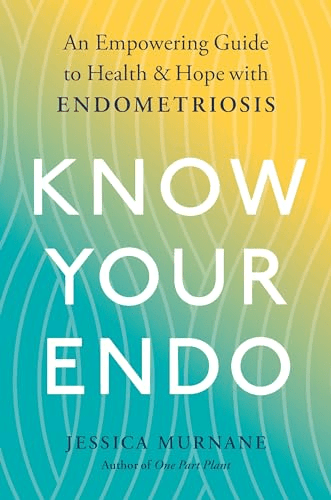
“Know Your Endo” was written by Jessica Murnane and merged the science and research on pain and endometriosis with the real-world experiences of people living with endo. This book also included management practices for endometriosis while also emphasizing that there is no cure. I highly recommend this book to anyone with endometriosis.
Here are some main takeaways:
If you’re a person living with endometriosis, caring for yourself needs to be your number-one priority.
Think about how much your pain and symptoms get in the way of your relationships, your work, and/or giving back to your community. Now think about how much more time you would have to give to them if you felt better.
Many people with endo can have inflammation of their appendix, colon, or the lining of their stomach that can cause bloat and swelling.
Endo fatigue is one of the hardest symptoms to manage – an intense, deep, and permeating feeling of exhaustion that can be hard to shake, no matter how hard you try.
Big inflammatories: processed and packaged foods, dairy, red meat, refined sugars and synthetic sweeteners, fried foods, soda, refined carbs, alcohol, and caffeine. **You are the only one who knows how your body feels when you eat certain foods, and it’s your responsibility to listen to it.**
4 out of 5 stars
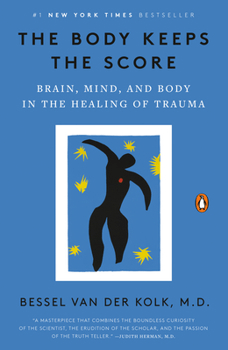
“The Body Keeps the Score” was an intense read about the effects of trauma and pathways to recovery written by Bessel Van Der Kolk, M.D. This book took me a whopping thirteen days to read – mostly because I found it pretty depressing and wasn’t eager to read it each day.I regularly read about traumatic experiences in the course of my work, and adding this book on top of that was sometimes too much. With that said, I learned SO much from this book and will post more about it at another time. I highly recommend this book to anyone who has experienced trauma. Here are some main lessons that stood out to me:
In today’s world, your zip code, even more than your genetic code, determines whether you will lead a safe and healthy life. Income, family structure, housing, employment, and educational opportunities affect risk of developing traumatic stress and access to effective help to address it. Poverty, unemployment, inferior schools, social isolation, widespread availability of guns, and substandard housing are all breeding grounds for trauma. Trauma breeds further trauma. Hurt people hurt other people.”
What has happened cannot be undone. What can be dealt with are the imprints of the trauma on the body, mind, and soul. The challenge of recovery is to reestablish ownership of your body and your mind – finding a way to become calm and focused; learning to maintain that calm in response to images, thoughts, sounds, or physical sensations that remind you of the past; finding a way to be fully alive in the present and engaged with the people around you; and not having to keep secrets from yourself, including secrets about the ways that you have managed to survive.
“The greatest sources of our suffering are the lies we tell ourselves.”
Treatments explored in this book include medications, sensorimotor psychotherapy and somatic experiencing, cognitive behavioral therapy, virtual reality therapy, acupuncture, massage, yoga, EMDR, writing to yourself, neurofeedback training, theater, self-awareness, and having a good support network.
Many psychiatrists today resort to doling out pills to relieve pain, anxiety, or depression, which doesn’t address the real issues: What are these patients trying to cope with? What are their internal or external resources? Do they have caring relationships with their bodies? Do they have dynamic interactions with other people? Whom can they count on? Are they members of a community? Do they have a sense of purpose? How can we help them feel in charge of their lives?
4 out of 5 stars
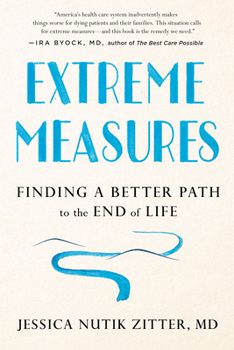
“Extreme Measures: Finding A Better Path to the End of Life” was written by Jessica Nutik Zitter, MD, an expert on the medical experience of death and dying who is double-boarded in the two specialties of pulmonary/critical care medicine and palliative care medicine – a rare combination. This book was fascinating, educational, emotional, and empowering. So many points and stories in this book will stick with me and I highly recommend this book to everyone. Here are some main points:
Often people die in the ICU on the end-of-life conveyer belt, where issues are treated until the patient dies. People who request treatment rarely understand the realities involved in “doing everything.” In the ICU, very few people have the opportunity to live life all the way through to the end. Too often the tools take life away from the dying.
There are certain treatments that Americans have come to see as their rights, whether or not the physician deems them to be beneficial in a particular case: breathing machines, feeding tubes, cardiac resuscitation with electric shocks and chest compressions, and dialysis. Most physicians feel they are powerless to withhold these treatments if the patient/family insists on their use.
Ask about the benefits and burdens of treatments, alternatives, and your or your family member’s prognosis.
Don’t expect your family to know your wishes or to make difficult decisions in the ICU. Identify what matters to you. What is your conception of a life worth living? Being free of pain? Engaging in relationships? Autonomy? Engaging in work and meaningful tasks? Living in your own home? Not being a physical/emotional/financial burden on your family? The best-laid paths to the end of life have been paved with ongoing reflection and communication. As people approach death, their priorities shift. Tools to convey your wishes include the Advance Directive, DNR order (good only for a particular admission at a particular time), and the POLST (follows you everywhere).
5 out of 5 stars
I look forward to reading, learning, and sharing more with you soon!





 Read Learn Share