
My intention is to post a Thoughtful Thursday column each week and share some of the insights I have learned in the past week. Here are some of the things I’ve learned this week:
Mental Performance Daily – Culture Killers
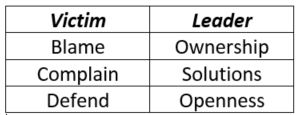
- BCD – blaming, complaining, and getting defensive – transfer of accountability and responsibility
- Be accountable, responsible, and coachable.
- Another culture killer – me over we mentality – put team over yourself. When the team has success, you have success. When the team gets noticed, you get noticed. Don’t be an energy sucker.
- Put we over me and eliminate BCD
TED Talks Daily – Why you think you look bad in photos
- You’ve been looking at a reflection of yourself your whole life – looking in a mirror. Your brain gets a clear idea of what you look like. When you’re seeing a photograph, you’re seeing the reverse. Most of us are not symmetrical in our facial attributes.
- Overcome this by looking at yourself in photos more.
- You may not resonate with how you are being portrayed. Not everyone feels confident in photos.
- Get curious and ask yourself what you’re struggling to accept about the image and whether it has anything to do with how you are being portrayed. Looking bad in photos has less to do with how you look and more to do with how you think.
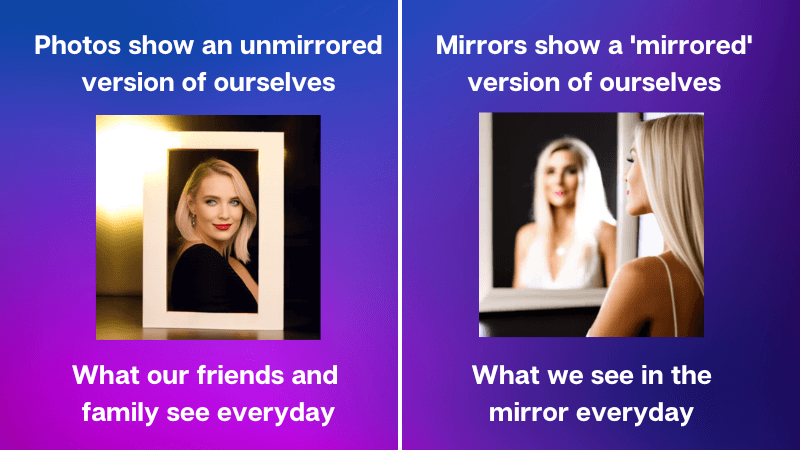
- You’ve taught yourself to hyper fixate on your insecurities.
- Focus instead on who you were with, what you were doing, and how you were feeling the moment the photo you were taken. When we change the way we look at things, the things we look at change.
- We’ve put unrealistic expectations on photography and our bodies. Disappointment is the gap that exists between expectation and reality. Photography’s only job is to capture a fraction of a second, but we’ve made these fractions of a second create a big narrative – such as I look bad in photos – that prevent us from showing up and being present in our lives.
- We’ve decided certain angles are better than others.
- Accomplishments, achievements, love, passion, creativity, and brilliance don’t change between photos. Your children, pets, and grandchildren see you at your worst angles and don’t love you any less or care about you any less. You are worthy of being photographed.
- We put pressure on how we are going to show up in photographs, and this pressure prevents a lot of us from showing up in photographs with and for the people we love the most.
Hidden Brain – The Secret to Gift Giving
- Obligations are probably the single biggest reason that gifts are given in the first place, whether it’s for Christmas, a birthday, an anniversary, or a graduation. When you get a gift, it feels like you have to return that gesture at an appropriate moment – whether it’s at that moment, the next birthday, etc.
- Recipients are often focused on the experience of the gift over the ownership of the gift. When you receive something, in the moment it might make you happy, but does it actually provide you value and utility and joy for the duration of owning whatever it is that you’ve received? Sometimes the things that bring you happiness in the moment are not the things that bring you happiness in the long-term.
- The surprise is something that gift givers think is critical to a recipient. When I give you a gift, I have this belief that you will only value that gift if you don’t expect receiving it. That is simply not true.

- A lot of people imagine that the reason gifts are exchanged is because we’re trying to make other people happy. But there are also selfish reasons for giving a gift, such as signaling who you are as a person and as a gift giver and signaling that you’re a creative gift giver. Sometimes people who think they’re creative make sure that the choices of gifts are creative even at the expense of the recipient. Ex: not giving the same gift to the same person another year and not giving the same gift to someone else
- The cost of a gift is not nearly as predictive in terms of happiness of the recipient as people tend to think.
- The research is pretty clear that recipients do not value socially conscious gifts as much as givers hope they would. Ex: charity donation, planting a tree, etc.

- Idea: family spreadsheet – “Whenever one of us has a desire for an item of some sort that exceeds some minimum expense, we put it on there as a potential gift that we would love to receive at some point. And what’s nice about that is when it’s time to fulfill my obligation, I’m not racking my brain trying to figure out what would make her happy. It still maintains an element of surprise in the form of the timing of the object itself. She might know that she wants item X, but she’s not going to know that I’m going to give it to her at a specific time.”

- Receiver is overjoyed when they get exactly what they want
- Experiential gifts – less of a wow factor upon opening, but providing a very valuable experience down the road
- Recommendation: if you’re going to give a gift, do it on a random day. The value that people get when they receive gifts on non-occasions is so much higher because they have no expectations.
I appreciated this post from Gabe the Bass Player this week:
https://www.gabethebassplayer.com/blog/the-next-episode
The Next Episode
December 6, 2024
We don’t have it. That’s what makes our lives different from the all the things we stream.
In streamer land we can always find out what’s next, we know the episode schedule, we have behind the scenes, we can binge it in two days and find out the end, or we can look up the end right now.
That’s why we’re drawn to movies and tv and podcasts and stories…because we long for a complete story where it all makes sense and the loose ends are perfectly tied.
But in real life we don’t have the next episode and we certainly don’t know the season finale. We’re living it.

I enjoyed this post from Seth’s Blog this week:
What if they’re right?
We spend a lot of time in our own heads, certain that our path and our method make sense. We often become more certain in the face of criticism or even suggestions.
This confidence is essential, as it allows us to lean into our project.
Once in a while, though, it might help to model the alternative. What if they’re right? How would that play out? If they’re right, what could I do with that insight?
If it’s helpful, run with it.
We can always go back to being right tomorrow.
I look forward to reading, learning, and sharing more with you soon!




 Read Learn Share