
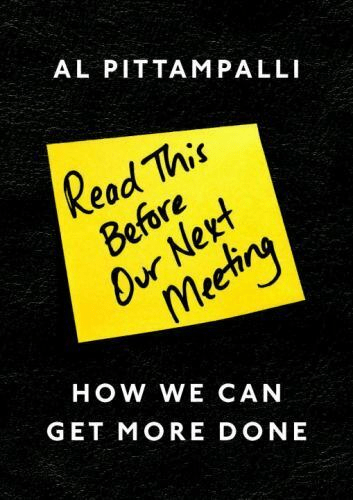
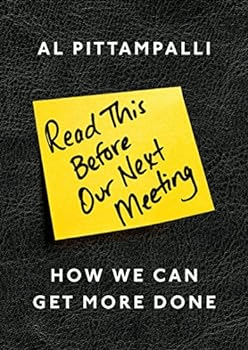
“Read This Before Our Next Meeting” was written by Al Pittampalli, the founder of the Modern Meeting Company, which has helped organizations hold more effective meetings. This book was direct and to the point.
In a world with fewer meetings, we’d have more time for our real work, the work we do that actually propels our organizations forward.
The modern meeting:
- doesn’t make decisions. Leaders do. Consult others via e-mail or one-on-one and make a preliminary decision.
- has two primary functions: conflict and coordination
- moves fast and ends on schedule. Strong deadlines force parties to resolve the hard decisions necessary for progress.
- limits the number of attendees.
- rejects the unprepared. Prepare an agenda.
- produces committed action plans. No minutes are required; you only need to know the decision and resulting action plan.
- refuses to be informational. Reading memos is mandatory.
- works only alongside a culture of brainstorming
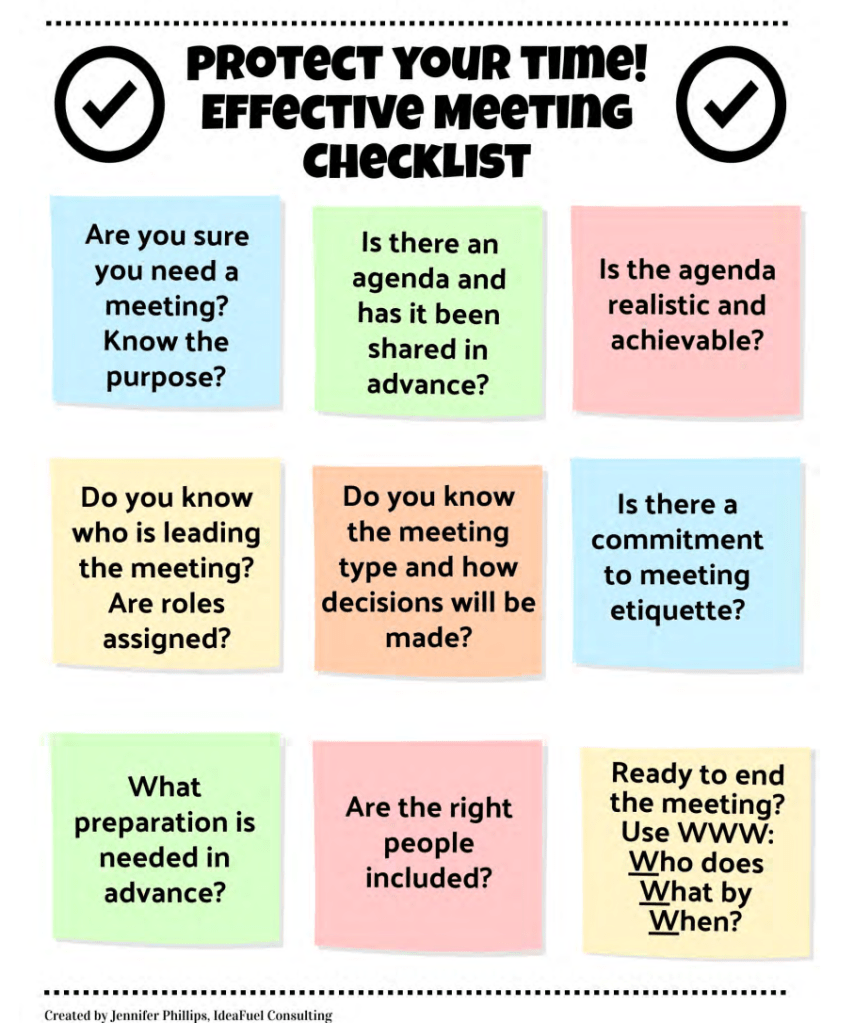
The modern meeting is for finalizing your preliminary decision, generating buy-in, and agreeing on next steps. In advance of the meeting, inform attendees of the decision you plan to make as well as the reasoning behind that decision.
During the meeting, allow attendees to ask questions, voice concerns, and propose modifications. If all goes well, a consensus is achieved, a decision is resolved, and an action plan is coordinated.
Invite only the people who are absolutely necessary for resolving the decision that has been presented. If you have no strong opinion, have no interest in the outcome, and are not instrumental for any coordination that needs to take place, you don’t need to attend.
Prepare an agenda. Every meeting should require pre-meeting work. The modern meeting is about conflict and coordination, two activities that hinge upon preparation.
8 principles of the modern meeting:
- Only after you’ve reached a preliminary decision can you call a meeting.
- Get everyone on the same page and create an action plan.
- Enforce firm meeting end times. The meeting ends, a decision is resolved, and participants get back to work. Start on time.
- Only people who are critical to the outcome are invited to the modern meeting. Small numbers allow decisions to be resolved quickly and plans to be coordinated smoothly.
- The modern meeting rejects the unprepared. An agenda is distributed well in advance and establishes the decision being debated or the action being coordinated. You must carefully think through different scenarios and come up with thoughtful responses.
- The modern meeting produces committed action plans. What actions are we committing to? Who is responsible for each action? When will those actions be completed? It’s the meeting leader’s responsibility to follow up and hold participants accountable for their commitments.
- If no action plan is necessary, neither is a meeting!
- Informational meetings aren’t necessary. Managers must write memos instead. Everyone must commit to reading them.
- The modern meeting is about decision and the narrowing of options. Brainstorming is necessary.
Amazon and Google are both notable in their meeting practices and share many elements of the modern meeting.
This was an interesting book. I agree with some of it, as I have had to attend several meetings just so that management or clients could “check a box” from their weekly to-do list that a meeting was held. This is not effective. However, in my current role, we occasionally have virtual video meetings so that we can get to know and see others we don’t see in person. I enjoy having time set aside for that.
I look forward to reading, learning, and sharing more with you soon!





 If your body confidence comes from liking how you look, it will rise and fall with every nice or negative comment, every acceptance or rejection, every good or bad photo, and every physical or mental fluctuation.



 Read Learn Share